21.09.2026
Philip Buczak received the DStatG prize for the best scientific publication produced as part of a doctoral thesis.
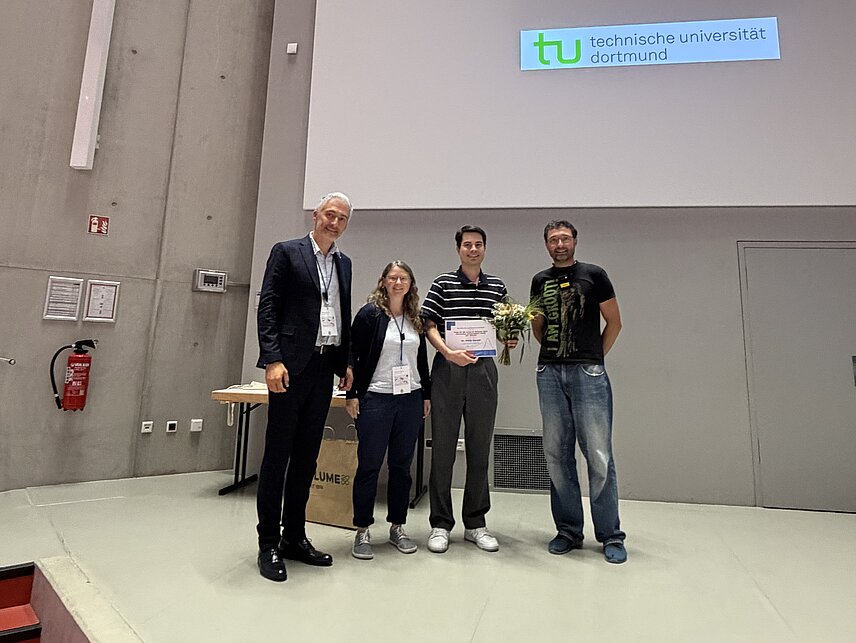 Photo © Enjeda Cekaj
School grades follow an order. So do responses on many rating scales. Yet for a machine-learning model, predicting such categories is not as straightforward as simply assigning them numbers. This is the problem at the center of Philip Buczak’s award-winning research. During Statistische Woche 2026 in Essen, he received the DStatG prize for the best scientific publication produced as part of a doctoral thesis.
The paper, “Frequency-adjusted borders ordinal forest: A novel tree ensemble method for ordinal prediction,” was published in the British Journal of Mathematical and Statistical Psychology. It introduces a new Random Forest-based method for ordinal outcomes – categories with a meaningful order, but without necessarily equal distances between them.
Building on Ordinal Forest
Random Forests do not inherently account for this ordering. Roman Hornung’s Ordinal Forest addressed this by using optimized numeric scores to represent ordered response categories. Philip Buczak’s Frequency-Adjusted Borders Ordinal Forest (fabOF) builds on this score-based approach but avoids the computationally expensive optimization step used by the reference method. Instead, fabOF uses a specially developed heuristic based on the frequencies of the response categories. In the study, this made fabOF faster than Ordinal Forest while showing promising predictive performance.
Philip Buczak tested fabOF in simulations and with data on 649 students from two Portuguese high schools. Their final grades in a language course were grouped into five ordered categories, providing a real-world example of the kind of ordinal outcome the method is designed to predict.
The method also addresses another question: which variables contribute most to a prediction? A tailored variable-importance measure identified factors including interest in higher education, the mother’s education, and study time as particularly relevant in the student example. Philip Buczak notes, however, that correlations between variables mean such results need to be interpreted with care.
Research developed during his doctorate
The publication grew out of Philip Buczak’s doctoral research at the Chair of Mathematical Statistics and Applications in Industry at TU Dortmund University, led by Prof. Markus Pauly. During parts of his doctorate, Philip Buczak was funded through RC Trust, which is also listed as an affiliation on the paper.
The award was presented during Statistische Woche 2026, held from 8 to 11 September in Essen. The annual meeting brought together the German Statistical Society and other organizations from academic and applied statistics.
Category
- Award
- Mathematical Statistics and Applications in Industry
Author
Patrick Wilking