22.09.2026
Linara Adilova will build and lead a new Chair of Machine Learning in Cologne.
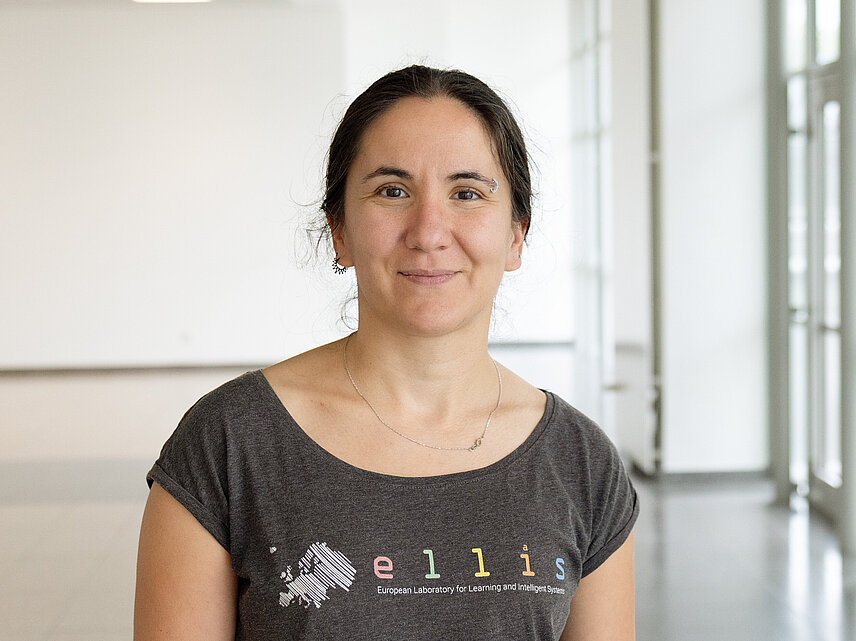 Linara Adilova/Photo: @ Patrick Wilking
Linara Adilova is taking the next step in a scientific career shaped by foundational questions in machine learning and trustworthy AI. On October 1, she will join the University of Cologne as Professor of Machine Learning, where she will build and lead the new Chair of Machine Learning at the Institute of Computer Science.
For Linara, the appointment connects several threads of her recent work: why deep neural networks generalize, how their behavior can be described mathematically, and how uncertainty, reliability, and understanding can become part of the way artificial intelligence is developed.
At the Research Center Trustworthy Data Science and Security (RC Trust) and TU Dortmund University, Linara has worked as a Postdoctoral Researcher and Young Investigator Group Leader. Her research focuses on the theoretical foundations of deep learning, especially the ability of neural networks to generalize from training data to new, unseen examples. This includes perspectives from high-dimensional geometry and information theory, but also broader questions of how machine learning systems can become more reliable, interpretable, and useful in practice.
In Cologne, she will continue this line of work while expanding it toward AI for Science. Her new chair will develop machine learning solutions for research questions across the natural sciences and other disciplines, supporting fields in which data-driven methods can help uncover patterns, test hypotheses, or open new forms of analysis.
Linara also plans to continue several projects that began at RC Trust and TU Dortmund University, while actively exploring new collaborations with colleagues in Cologne. In teaching, she will take over the Data Science lecture for bachelor’s students and later develop advanced courses based on her core research areas. Building a functioning research group will be one of her central priorities.
Her move to Cologne is not a departure from the networks that have shaped her recent work. Linara plans to maintain close connections with Lamarr and ELLIS, where she has been an active member since her PhD. She has also proposed staying associated with RC Trust beyond current projects.
“I was very lucky to find this position at exactly the right time,” Linara says. “And I was even more lucky that the RC Trust group entrusted me with the role of a junior research group leader. This support definitely helped me grow further.”
For RC Trust, her appointment is also a sign of how early-career researchers can develop their own profile within an interdisciplinary research environment. Linara’s new role will allow her to pursue the question that has accompanied her work throughout: how machine learning can become not only more powerful, but also more effective, useful, and scientifically grounded – without handing over the development of knowledge to AI itself.
Category
- Staff
Author
Patrick Wilking