03.12.2025
Prof. Christian Glaser shows how AI is driving new advances in neutrino astronomy.
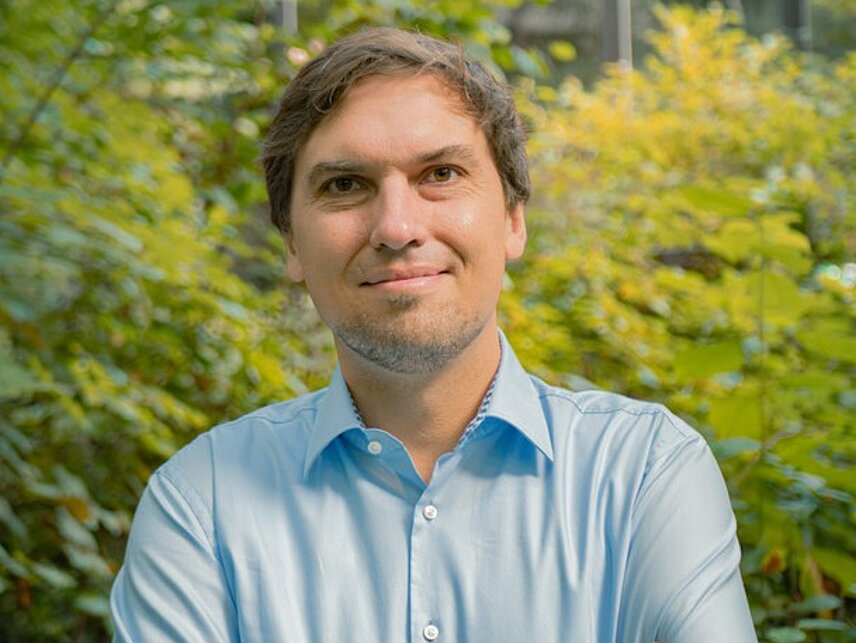 Photo: © Beran Kosan
Prof. Christian Glaser from TU Dortmund University will give insights into how modern AI methods are reshaping neutrino astronomy. His talk, “How Deep Learning and Differential Programming Accelerate Progress in Neutrino Astronomy,” takes place on 8 December 2025 from 2:15 to 3:45 PM in JvF25/3-303 – Conference Room (Lamarr/RC Trust Dortmund) as part of the AI Colloquium.
Cosmic neutrinos are invaluable messengers of the universe’s most extreme environments, yet they remain extraordinarily difficult to detect. In his lecture, Glaser will outline how deep learning, differential programming, and novel AI-driven reconstruction techniques open up new possibilities for identifying and analyzing these elusive particles. His talk spans real-time deep learning on embedded systems, end-to-end detector optimization, neural posterior estimation, and early steps toward a multimessenger foundation model for astroparticle physics.
Glaser is an astroparticle physicist whose work focuses on high-energy cosmic rays and neutrinos, combining experimental expertise with cutting-edge machine learning. After earning his PhD from RWTH Aachen University in 2017, he conducted research at the University of California Irvine before joining Uppsala University, where he became Associate Professor in 2023. He is involved in several international projects, including the ARIANNA experiment in Antarctica, the Radio Neutrino Observatory in Greenland, and the development of IceCube-Gen2 at the South Pole. Recently, he received an ERC grant to optimize future radio detectors for neutrinos using deep learning and differential programming.
AI Colloquium
The AI Colloquium is a series of lectures dedicated to cutting-edge research in the field of machine learning and artificial intelligence, coorganized by the Lamarr Institute for Machine Learning and Artificial Intelligence (Lamarr Institute), the Research Center Trustworthy Data Science and Security (RC Trust), and the Center for Data Science & Simulation at TU Dortmund University (DoDas).
Category
- Talk
- Network