19.06.2026
Ivan Habernal joined AI & JUSTICE at the High Court in Prague, where legal AI moved from debate to practice.
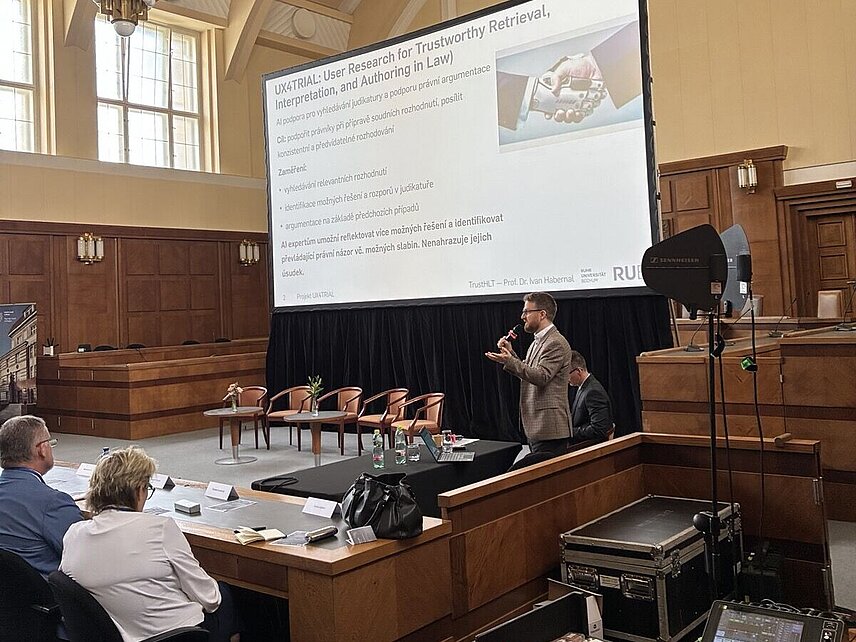 Photocredit: Tomas Koref
For years, discussions about artificial intelligence in justice have often sounded like debates about the future. Should courts use AI? Could judges rely on language models? What would happen if such systems made mistakes?
At the AI & JUSTICE “One Year After” conference in Prague, that future felt much closer. The central question was no longer whether AI might one day enter the legal system. It was how existing tools, prototypes, and pilot projects are already beginning to shape legal work and what needs to happen before they can be trusted.
The conference took place on June 16, 2026, at the High Court in Prague, Czech Republic. It brought together representatives from the judiciary, government, public administration, academia, and the technology sector to discuss how artificial intelligence can be used in legal and judicial practice.
The event focused on a practical shift: AI in justice is no longer only a theoretical concern. Live demonstrations and project presentations showed how AI tools may support legal research, analyze case law, process transcripts, or assist with drafting materials for judges.
That does not mean that courts are ready to hand over responsibility to machines. Quite the opposite. A recurring message of the conference was that AI may support administrative and analytical work, but it must not replace judicial decision-making. The final responsibility for legal decisions remains with judges.
This distinction is crucial. In domains such as law, errors are not merely technical defects. They can affect rights, obligations, and trust in institutions. A hallucinated source, an unreliable summary, or an opaque recommendation may have consequences that go far beyond an incorrect chatbot answer.
Prof. Ivan Habernal joined the practical panel with a presentation on UX4TRIAL, a collaborative research project with the High Court in Prague concerned with user experience for trustworthy search, interpretation, and legal drafting from the perspective of judges and their assistants. The project addresses a central challenge for legal AI: systems must not only produce outputs, but do so in ways that judges can rely on them.
After the conference, Habernal reflected on what he had seen in unusually direct terms. In his assessment, large language models in justice are “already a real thing” – and this makes the current state of the field deeply concerning.
He pointed to several risks: systems built quickly by laypeople, reliance on proprietary cloud-based models, severe hallucination problems, and a lack of any rigorous evaluation. His conclusion was clear: “We must do better.”
This is not a rejection of AI in justice. It is an argument for taking it seriously. If these systems are already being tested or used in legal environments, then research, evaluation, documentation, and accountability cannot remain secondary concerns. They become the foundation for responsible adoption.
At Ruhr University Bochum, Ivan Habernal leads the Trustworthy Human Language Technologies (TrustHLT) group at the Faculty of Computer Science. He is also a member of the Research Center Trustworthy Data Science and Security (RC Trust).
His group conducts research in privacy-preserving natural language processing and legal NLP. Both areas are directly relevant to the questions raised in Prague. Legal AI must work with complex language, institutional constraints, and high expectations of reliability. It must also be evaluated in ways that reflect real legal workflows.
The Prague conference made visible why this work matters. Artificial intelligence can help judges navigate large volumes of information, but useful support depends on more than speed. It requires systems that are robust, transparent, carefully evaluated, and embedded in clear rules of responsibility.
AI & JUSTICE “One Year After” was held on June 16, 2026, at the High Court in Prague. The conference was organized by the High Court in Prague in cooperation with the Center for Digitalization and Artificial Intelligence in Justice (CENDAI) and the Judicial Academy.
The event followed up on earlier discussions about artificial intelligence in justice and focused on practical projects, pilot applications, and the responsible use of AI in legal and judicial contexts.
Category
- Network
- Event
Author
Patrick Wilking