20.05.2026
Congratulations to Sabine Wehnert on successfully defending her dissertation at Otto von Guericke University Magdeburg.
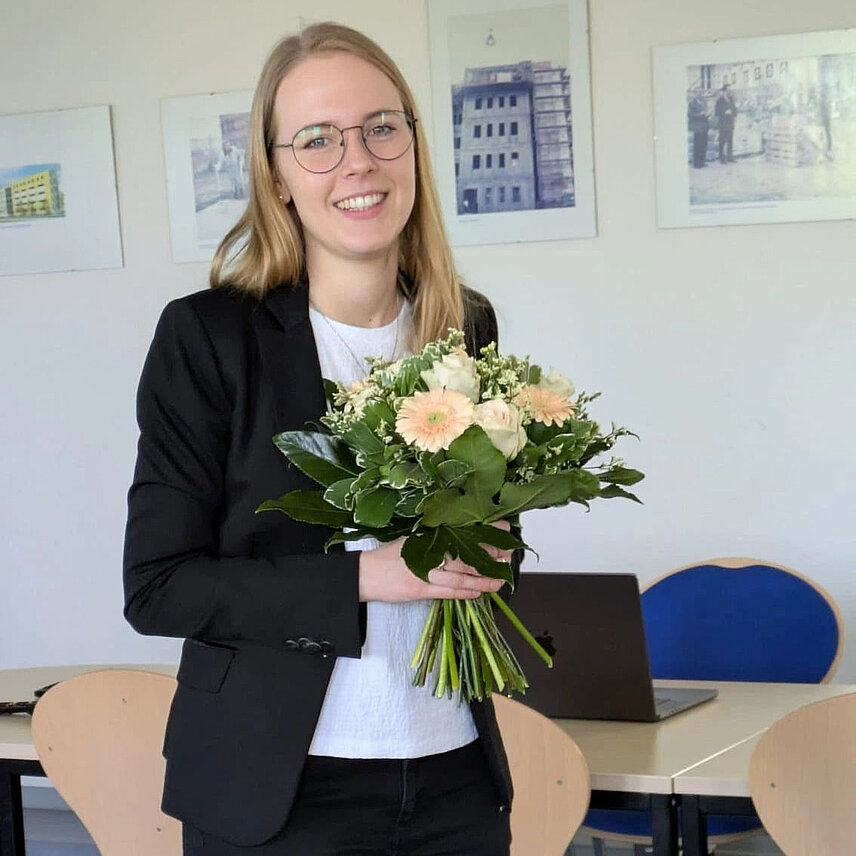 Photo: Sabine Wehnert
Artificial intelligence is becoming increasingly capable of processing legal information. It can summarize documents, retrieve relevant passages, and support legal research within seconds. But in legal contexts, speed alone is not enough.
Legal AI systems need to help users understand where information comes from, how legal sources relate to one another, and why certain results are relevant. This need for transparency and trustworthiness forms an important motivation behind Sabine Wehnert’s research.
A successful dissertation defense in Magdeburg
Sabine Wehnert has successfully defended her dissertation at the Otto von Guericke University Magdeburg. Her thesis, From Explainable to Justifiable Legal Artificial Intelligence: Structuring Search and Knowledge Derived from Legal Textbooks, investigates how legal knowledge can be extracted, structured, and made searchable in ways that support more transparent and useful legal research.
At the core of her dissertation is the challenge of working with interconnected but heterogeneous legal materials, including legal textbooks, statutes, and case law. By structuring knowledge from legal textbooks and linking it to other legal sources, her work contributes to AI-supported legal research that is not only technically effective, but also easier for users to inspect and understand.
From explainability toward justifiability
While explainability is a widely discussed topic in AI, legal applications raise additional questions. In law, it is often not enough for a system to provide an explanation; users also need to assess whether a result is meaningful, reliable, and grounded in the relevant legal context.
In Sabine Wehnert’s dissertation, the idea of justifiable legal AI emerges from this broader research trajectory. It reflects an important perspective for future work: legal AI systems should not only retrieve or explain information, but also support users in evaluating why a result can be considered well-founded.
Her research brings together approaches from Legal NLP, information retrieval, knowledge graphs, and human-centered AI. Together, these methods help explore how legal information can be represented and accessed in ways that support transparency, trust, and practical usability.
Continuing this work at RC Trust
Since October, Sabine Wehnert has been part of Prof. Ivan Habernal’s Trustworthy Human Language Technologies group at the Research Center Trustworthy Data Science and Security, where she works as a postdoctoral researcher.
At Ruhr University Bochum, she continues her work at the intersection of Legal NLP, search, and explainability, developing approaches that help make AI systems in legal contexts more robust, understandable, and practically useful.
Her research fits closely with the broader mission of the TrustHLT group, which focuses on trustworthy natural language processing, privacy-preserving NLP, and legal NLP. Together, these research areas explore how language technologies can be designed responsibly in sensitive domains such as law.
Category
- Staff
Author
Patrick Wilking