02.09.2026
Nicole Krämer joined first Ruhr Innovation Lab’s Future Dialogue on digital sovereignty, bringing an RC Trust perspective to the debate.
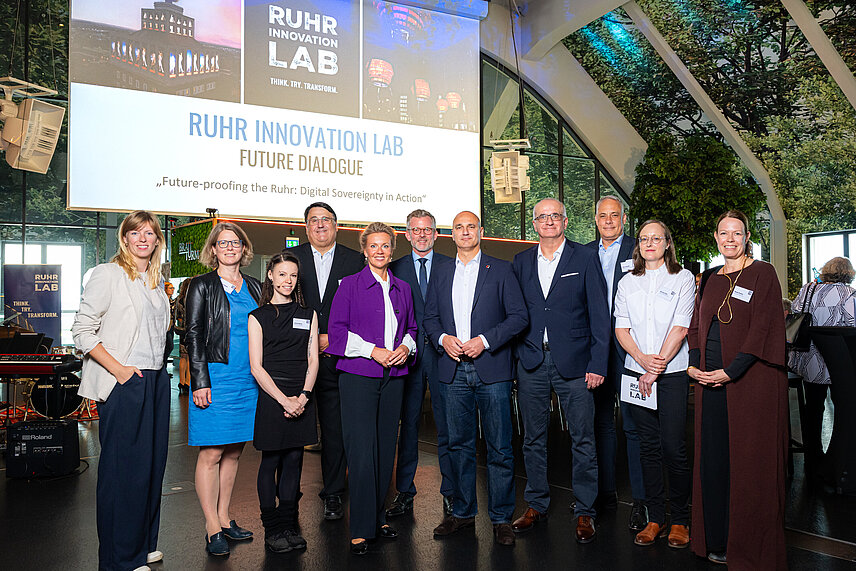 Photo: Simon Bierwald
Who controls our data? How dependent are we on digital infrastructures? And what does it take for people to use artificial intelligence with confidence rather than simply rely on it? These questions came together at the first Future Dialogue of the Ruhr Innovation Lab on August 31, 2026. Under the title Future-proofing the Ruhr: Digital Sovereignty in Action, around 80 participants gathered at the Dortmunder U to discuss what digital sovereignty can mean in practice.
For RC Trust, the topic reaches beyond technological independence. Whether people can act confidently in digital environments also depends on whether they understand the systems they encounter, how they assess their reliability, and when they decide to trust them.
Nicole Krämer brought this perspective to the evening’s Fishbowl discussion. Krämer is Scientific Director of RC Trust and Professor of Social Psychology: Media and Communication at the University of Duisburg-Essen. Her research examines the social and psychological dimensions of digital technologies, including human interaction with AI, social media, misinformation, robots, and virtual agents.
This human perspective complemented a discussion deliberately designed to bring different fields together. Following an opening by NRW Minister of Culture and Science Ina Brandes and a keynote by Prof. Karola Marky, head of the Digital Sovereignty Lab at Ruhr University Bochum, representatives from academia, politics, business, and civil society joined the Fishbowl. Members of the audience could also enter the discussion.
The cross-sector approach reflected the broader idea behind the Ruhr Innovation Lab. Established by Ruhr University Bochum and TU Dortmund University, it is intended as a space for experimenting with new forms of cooperation in research, transfer, and engagement. The Research Alliance Ruhr, of which RC Trust is part, is among the existing research structures on which this cooperation builds.
Brandes placed this collaborative approach at the center of her opening remarks: “Excellence is always possible when old parochial thinking in the Ruhr region is overcome and common strengths are sought.”
Digital sovereignty makes clear why such different perspectives are needed. Secure infrastructures and control over data matter. But technologies ultimately enter workplaces, institutions, public debate, and everyday life through people. Understanding how they perceive, evaluate, and interact with digital systems is therefore part of understanding what sovereignty in a digital society can actually mean.
For RC Trust, the Future Dialogue offered a fitting setting for exactly this conversation: connecting questions of technical trustworthiness with the people who have to navigate the technologies built around them.
Editorial note: A report on the Future Dialogue was first published by Ruhr University Bochum. This article takes an RC Trust perspective on the event and its discussion of digital sovereignty.
Category
- Talk
- Network
- Event
Author
Patrick Wilking