18.12.2025
Invited by the German Embassy in Bangkok, Professor Nicole Krämer delivered a keynote on the psychological effects of disinformation – a topic of growing global relevance.
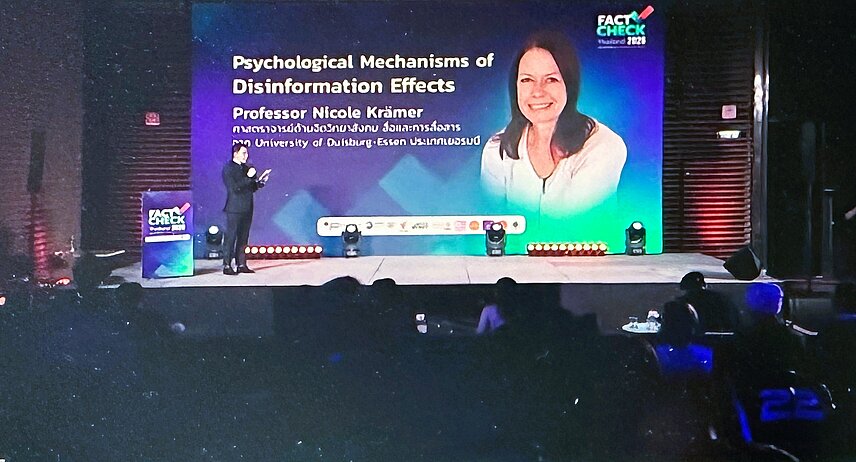 Photo: Nicole Krämer
At the “Fact Check Thailand 2026” event in Bangkok, individuals and initiatives committed to combating disinformation were recognised for their engagement in strengthening reliable public discourse. With Thailand heading toward national elections in 2026, the event sent a strong signal about the importance of verified information, media literacy and democratic resilience in the digital age.
In this context, Professor Nicole Krämer was invited by the German Embassy in Thailand to deliver a keynote titled “Psychological mechanisms of disinformation effects.” Her contribution added an academic perspective to a forum that deliberately brought together civil society, media professionals and international partners to address one of the most pressing societal challenges of our time.
Krämer’s keynote explored how cognitive and emotional processes make people susceptible to disinformation, including psychological biases and social dynamics that can shape beliefs, behaviours and collective attitudes. Research in the field shows that mechanisms such as confirmation bias, emotional arousal, group identity and cognitive shortcuts can influence how individuals interpret and spread misleading narratives — sometimes even unconsciously.
Drawing on decades of interdisciplinary work on media psychology and human-technology interaction, she highlighted how these mechanisms don’t just distort perceptions; they can also influence social cohesion, electoral processes and public decision-making if left unaddressed. The forum — part of the “Fact-Check Thailand 2026” initiative, which includes training for journalists, youth and civil society — offers a platform for building practical skills in verification, critical thinking and transparent reporting.
The German Embassy’s engagement with Thai partners underscores the importance of international collaboration in understanding and countering digital threats. It emphasises that psychological insights are essential not only for academic understanding but for effective public policy, resilient communities and informed citizens across diverse societies.
Category
- Network
- Event