16.10.2026
Dr. Annika Bush publishes new volume on AI and sustainability, building on work from her RC Trust time.
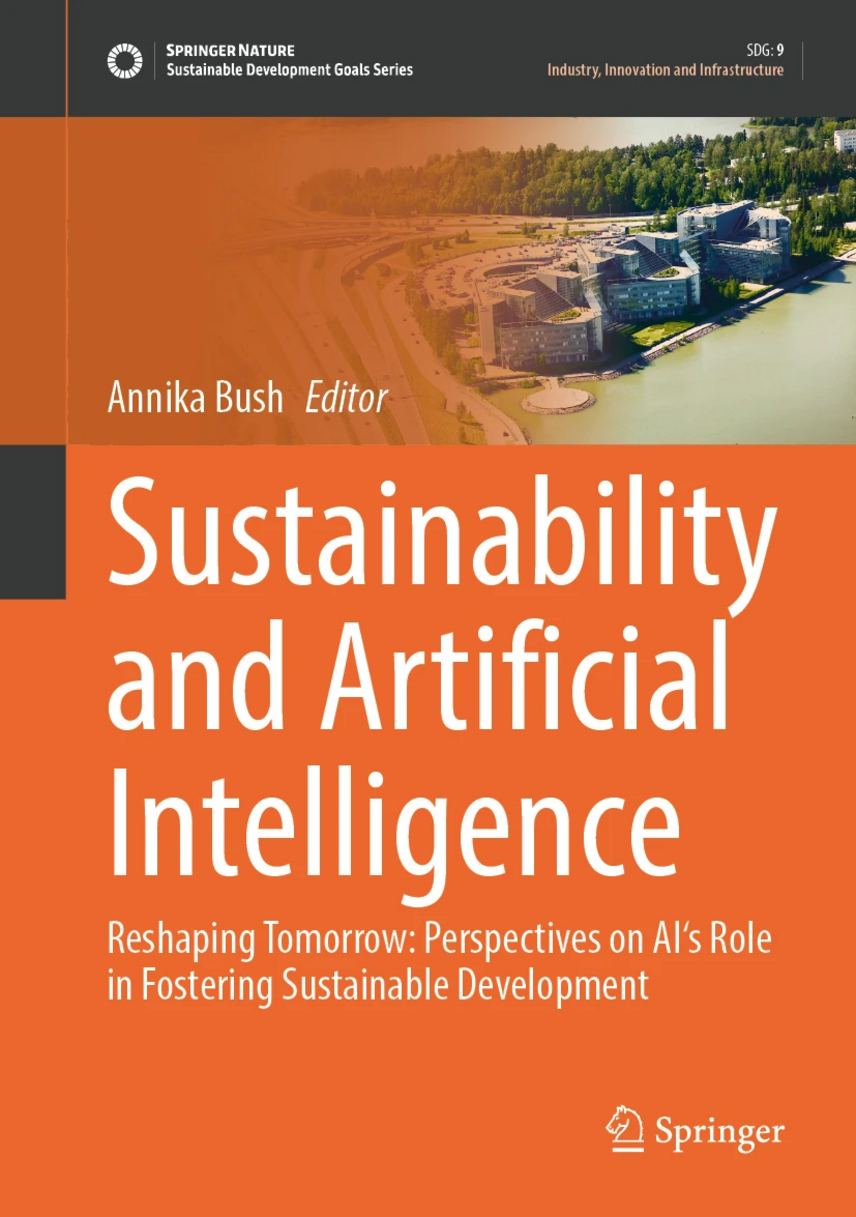 Cover Sustainability and Artificial Intelligence © Springer
When artificial intelligence meets one of the most pressing challenges of our time – sustainability – the result is a field full of both promise and complexity. With the new volume Sustainability and Artificial Intelligence: Reshaping Tomorrow: Perspectives on AI's Role in Fostering Sustainable Development, RC Trust alumna Dr. Annika Bush brings together international perspectives on exactly this intersection.
The eBook was published by Springer Nature in October 2026 as part of the Sustainable Development Goals Series, highlighting its relevance for global scientific and policy debates.
Building on research at RC Trust
The work on this volume is closely connected to Annika Bush’s time at the Research Center Trustworthy Data Science and Security (RC Trust), where she was a postdoctoral researcher at the chair of Data Science and Data Engineering at TU Dortmund University, led by Founding Director Prof. Emmanuel Müller.
Her interdisciplinary research – spanning artificial intelligence, sustainability, and societal impact – forms the foundation for the themes explored in the book. By bringing together technical perspectives with ethical considerations, the volume reflects an approach that has been central to RC Trust’s mission: developing trustworthy and socially responsible AI.
AI and sustainability: potential and paradox
The book addresses a key question: how can artificial intelligence contribute to sustainable development without creating new challenges?
Contributors from different disciplines explore how AI is already shaping solutions–from improving food systems and industrial processes to supporting the identification of geothermal resources. At the same time, they critically examine what is often described as the “sustainability paradox” of AI: while these technologies can help address environmental challenges, they also require significant computational resources and energy.
To navigate this tension, the volume proposes new frameworks for responsible AI development and highlights governance approaches that aim to align technological innovation with sustainability goals.
A global and interdisciplinary perspective
As part of Springer Nature’s Sustainable Development Goals Series, the book is embedded in a broader international research context. The series brings together contributions that address the United Nations’ seventeen Sustainable Development Goals, emphasizing interdisciplinary collaboration across science, policy, and society.
In this context, the volume not only contributes to ongoing academic discussions but also aims to provide orientation for decision-makers working at the intersection of technology and sustainability.
Continuing research beyond institutions
Today, Dr. Annika Bush is a DAAD PRIME Fellow at the Smithsonian Tropical Research Institute (STRI) in Panama and the Leibniz Center for Tropical Marine Research. Her current research focuses on developing frameworks for AI-supported collaboration between marine research stations and local communities – an approach that seeks to combine technological innovation with respect for traditional knowledge systems.
Her trajectory illustrates how research initiated in one institutional context can continue to evolve internationally, contributing to new collaborations and perspectives.
Publication details
The edited volume Sustainability and Artificial Intelligence: Reshaping Tomorrow was published as an eBook by Springer Nature on October 12, 2026 (ISBN 978-3-032-13396-0). A softcover edition is scheduled for October 27, 2027 (ISBN 978-3-032-13398-4).
Category
- Publication
Author
Patrick Wilking