23.03.2026
Giulia Barbareschi joins global network on inclusive human augmentation.
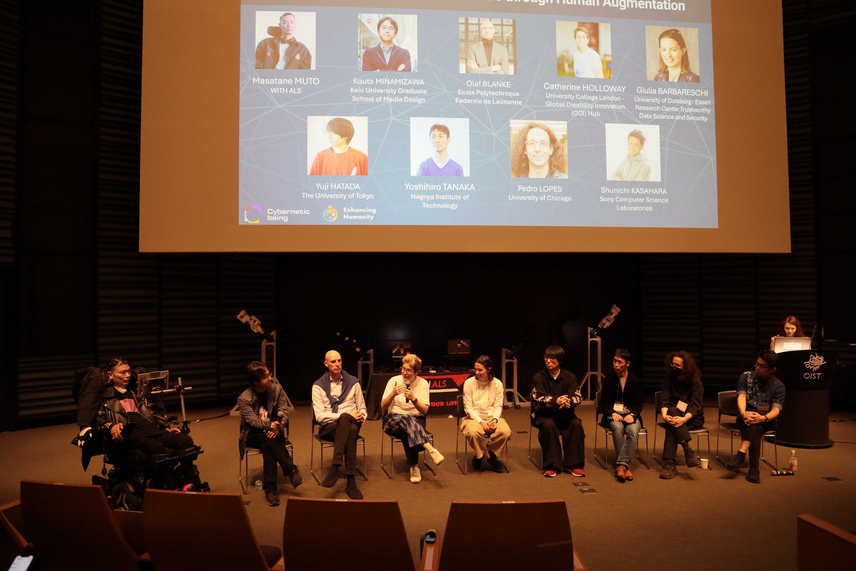 Photo: Giulia Barbareschi
How can technology expand human abilities–without leaving people behind?
This question is at the heart of the new international research initiative Enhancing Humanity - Inclusive Future through Human Augmentation, a global collaboration network that brings together leading experts from across Europe, the United States, and Japan. The program focuses on developing next-generation human augmentation technologies that enable more inclusive participation in society–particularly for people affected by disability, aging, or structural inequality across the Globe.
Funded by the Japan Science and Technology Agency under the ASPIRE program, the initiative will run until 2030 and combines technological innovation with real-world validation. Rather than approaching augmentation as a futuristic concept, the network explores how emerging technologies can address concrete societal challenges today–across education, work, and everyday life.
At the center of this effort is the idea that inclusion is not a constraint, but a driver of innovation. By integrating perspectives from diverse user groups and cultural contexts, the initiative aims to develop technologies that are not only advanced, but also accessible, usable, and socially meaningful.
The research spans a wide range of fields, including artificial intelligence, robotics, virtual reality, haptics, wearable interfaces, and cognitive science. Key focus areas include avatar-mediated remote work, AI-supported learning and skill transfer, and the development of affordable augmentation technologies for underserved communities. A distinctive feature of the program is its international residency model, which enables early-career researchers to work across institutions and disciplines–building a new generation of globally connected scientists.
Prof. Giulia Barbareschi, from the Research Center Trustworthy Data Science and Security (RC Trust) and the University of Duisburg-Essen, contributes her expertise in inclusive technology and participatory design. Her work focuses on how technologies can be developed in close collaboration with marginalized communities to ensure that innovation reflects real needs and lived experiences.
Through her involvement, RC Trust is part of a global conversation on how to design technologies that are both powerful and responsible. The initiative highlights a shift in perspective: from asking what technology can do, to asking who it works for–and under which conditions.
By connecting international research excellence with societal impact, “Enhancing Humanity” aims to shape a future in which technological progress and inclusion go hand in hand.
Category
- Network
Author
Patrick Wilking