03.02.2026
At the NRW State Parliament, Nicole Krämer discussed how social media influences political discourse and democratic processes.
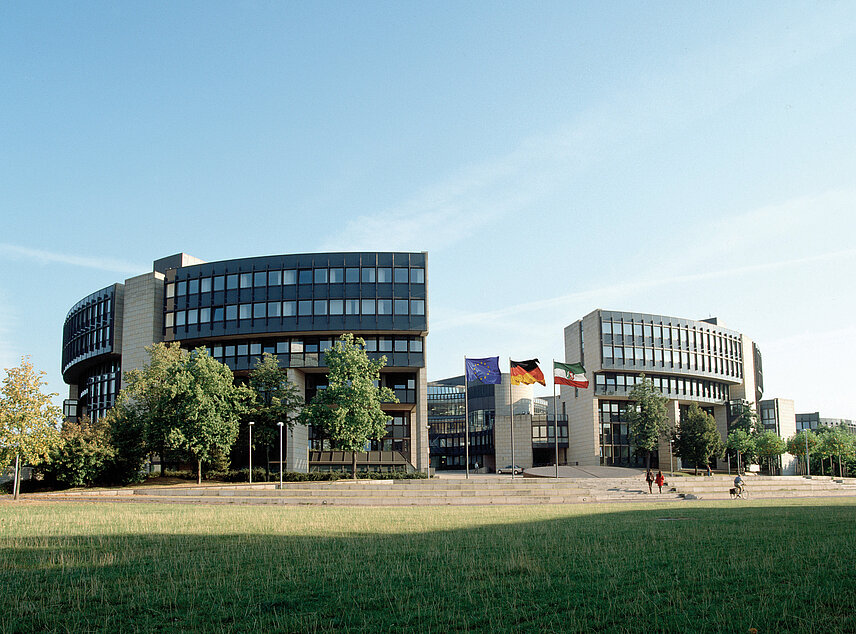 Photo: Landtag NRW/Bernd Schälte
On 26 January 2026, Professor Nicole Krämer spoke at the Landtag of North Rhine-Westphalia in Düsseldorf, presenting her research at a meeting of the CDU parliamentary group. Her talk, titled Effects of social media on the political discourse, addressed one of the most pressing societal challenges of our time: how digital platforms shape political opinion, debate and democratic participation.
In her presentation, Krämer drew on extensive research in media psychology and communication science to explain why social media have become a central arena for political discourse. While platforms enable low-threshold access to political information, cross-border exchange and civic mobilisation, they also amplify risks such as polarisation, echo chambers and the rapid spread of disinformation. These dynamics, she emphasised, are not merely technological but deeply rooted in human psychology.
Krämer highlighted how cognitive biases, emotional framing and social reinforcement influence how people perceive and share political content online. Individuals tend to engage more strongly with information that aligns with their existing beliefs, while contradictory information is often ignored or rejected. Algorithms can intensify these tendencies by prioritising familiar viewpoints, contributing to fragmented public spheres and hardened political positions.
A particular focus of the talk was the role of disinformation in political communication. Krämer explained why false or misleading information can have lasting effects even after it has been corrected, and why emotionally charged content spreads faster and wider than factual reporting. In the context of elections and political decision-making, these mechanisms pose significant challenges for democratic societies.
The discussion at the NRW State Parliament underlined the importance of evidence-based insights for political actors. Understanding how social media environments affect opinion formation is essential for developing effective strategies in political communication, regulation and civic education.
By bringing scientific expertise directly into parliamentary debate, the presentation demonstrated how research conducted at the RC Trust contributes to addressing real-world societal issues. Nicole Krämer’s engagement in Düsseldorf highlights the growing demand for interdisciplinary research that connects psychology, digital technologies and democracy – and positions RC Trust as a key contributor to informed political discourse in North Rhine-Westphalia and beyond.
Category
- Network
Author
Patrick Wilking