19.06.2026
Nicole Krämer (RC Trust) and Nikol Rummel (CAIS) supported the German Psychological Society in its mission to put human-centered AI in focus.
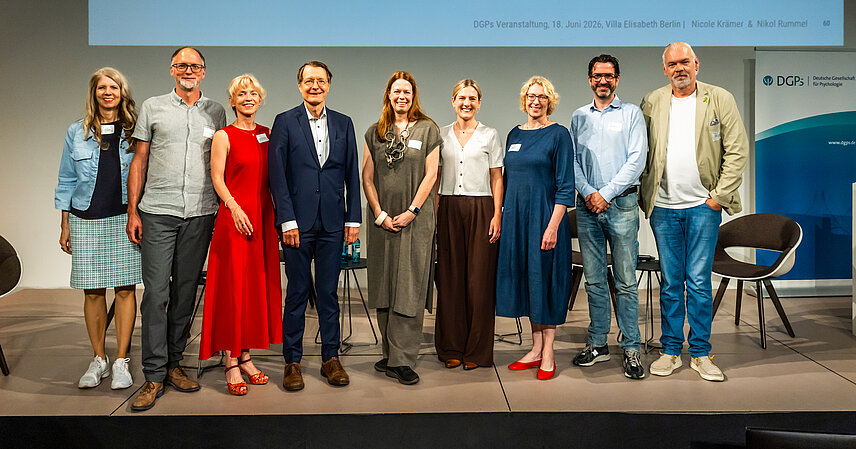 Photocredit: Rolf Schulten/Fotograf
Artificial intelligence is often discussed as a question of technology: Which systems are most powerful? Which models are most efficient? Which rules are needed to keep them in check? But the more deeply AI enters schools, workplaces and healthcare, the clearer it becomes that the decisive questions are also psychological.
How do people understand AI systems? When do they trust them? When do they rely on them too much – or too little? And how can digital technologies be designed so that they support humans in their decision-making instead of overwhelming them?
These questions shaped the conference Designing Human-Centered AI: Psychological Perspectives for Education, Work and Health, hosted by the German Psychological Society (DGPs) on 18 June 2026 at Villa Elisabeth in Berlin. The event brought together perspectives from psychology, politics, administration, practice and AI research to discuss how artificial intelligence can be developed, evaluated and regulated in ways that remain oriented toward people.
For the Research Center Trustworthy Data Science and Security (RC Trust), this focus connects directly to one of its central concerns: trustworthy technology cannot be understood through technical performance alone. It also depends on how people perceive systems, interact with them, assign responsibility and build trust. In this sense, psychology is not an additional perspective on AI. It is one of the disciplines that helps explain whether AI systems can become understandable, reliable and socially embedded.
Prof. Nicole Krämer, Scientific Director of RC Trust and Professor of Social Psychology: Media and Communication at the University of Duisburg-Essen, helped shape this dialogue from the start. Together with Prof. Nikol Rummel from CAIS and Ruhr University Bochum, she was responsible for the scientific conception and organization of the conference. Together, they opened the event and introduced the central theme: why psychological theories and empirical findings are essential for designing AI that works with and for people.
The conference focused on three areas in which AI is already changing everyday structures: education, work and health. In education, AI can support learning processes, but it also raises questions about autonomy, assessment and the role of teachers. In the workplace, AI systems may assist decisions or reorganize tasks, while also creating new demands on employees. In healthcare, the discussion included contributions from Prof. Dr. Karl Lauterbach, MdB, former Federal Minister of Health, who addressed opportunities and challenges of AI in medical contexts.
Across these fields, a recurring question emerged: What does it mean to make AI human-centered in practice? The answer does not lie in a single design principle or legal instrument. It requires evidence about perception, trust, motivation, acceptance, bias, vulnerability and decision-making. It also requires spaces where scientific evidence can meet political and practical needs.
By organizing and sponsoring this conference, RC Trust contributed to such a space. The event showed how interdisciplinary research can inform public debates on AI regulation and responsible innovation without reducing them to either technical feasibility or abstract risk. Nicole Krämer’s involvement highlighted the role of psychological expertise within RC Trust: connecting human behavior, digital technologies and societal responsibility.
The conference was hosted by the German Psychological Society (DGPs) and supported by RC Trust, the University Alliance Ruhr and CAIS. The scientific conception and organization were led by Prof. Dr. Nicole Krämer (RC Trust, University Alliance Ruhr and University of Duisburg-Essen) together with Prof. Dr. Nikol Rummel (CAIS gGmbH and Ruhr University Bochum).
Category
- Network
- Event
Author
Patrick Wilking