20.02.2026
Prof. Edward A. Lee questions digital knowledge at the AI Colloquium.
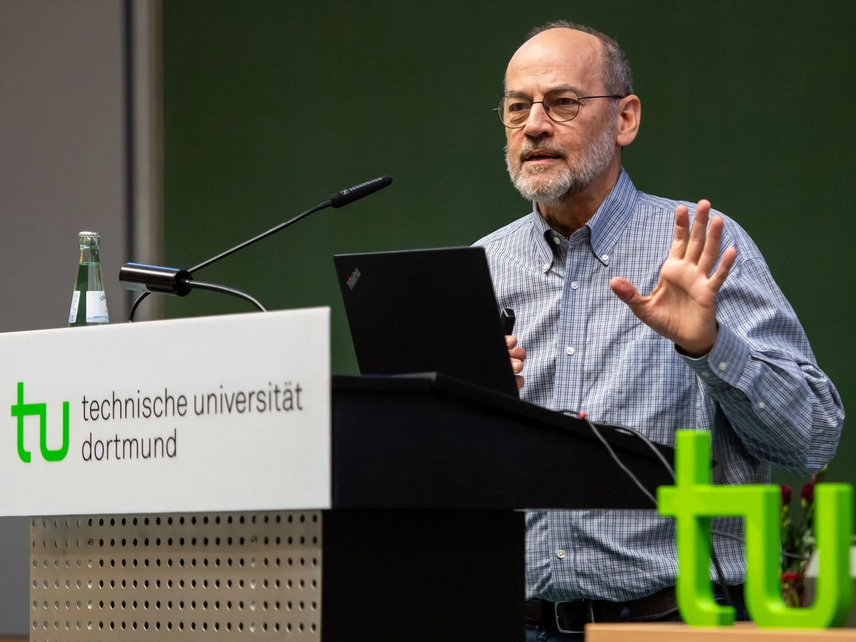 Photo: Hesham Elsherif/TU Dortmund
Data-driven technologies such as large language models have made remarkable progress in recent years. Yet advances in cyber-physical systems – from robotics to autonomous machines – have been far slower. Why is that? Is it simply a matter of insufficient training data, or does the explanation lie deeper?
In his talk Is Information Digital? A Defense of Reality, Edward A. Lee explores a fundamental question at the heart of artificial intelligence and computer science: Can all knowledge about the physical world be captured through digital representation and objective observation?
Lee argues that there may be a profound difference between learning through observation and learning through embodied interaction. Can one learn to ride a bicycle merely by watching others? Drawing on concepts from computer science such as zero-knowledge proofs and bisimulation – and connecting them to Shannon’s information theory – he suggests that objective observation may reveal only a limited subset of the information embedded in physical reality. Some aspects of the real world, he argues, cannot be fully represented digitally. If this is true, then learning – even for machines – may require interaction with the physical world.
The lecture takes place on 5 March 2026, 13:00–15:00, in OH14/E-23 – CS Lecture Hall (OH14) at TU Dortmund University.
Professor Lee is Distinguished Professor Emeritus in Electrical Engineering and Computer Sciences at the University of California, Berkeley, where he has served on the faculty since 1986. His research focuses on cyber-physical systems that integrate physical dynamics with software and networks, with particular emphasis on deterministic models for engineering reliable systems. He has authored seven books, delivered hundreds of invited talks worldwide, and led influential open-source projects such as Ptolemy and Lingua Franca. His work bridges technical depth with philosophical reflection on the limits and responsibilities of digital technology.
Lee has previously visited TU Dortmund in 2025, where he delivered the lecture Will Embodied AI Become Sentient? as part of the Distinguished Lecture Series Trustworthy AI. His return now offers the opportunity to deepen this discussion – this time by questioning the very assumption that information itself is fully digital.
Professor Lee’s visit is hosted by the Faculty of Computer Science at TU Dortmund University. His lecture is additionally embedded within the AI Colloquium framework, reflecting the shared interest in foundational questions of trustworthy artificial intelligence and digital systems.
AI Colloquium
The AI Colloquium is a series of lectures dedicated to cutting-edge research in the field of machine learning and artificial intelligence, coorganized by the Research Center Trustworthy Data Science and Security (RC Trust), the Lamarr Institute for Machine Learning and Artificial Intelligence (Lamarr Institute), and the Center for Data Science & Simulation at TU Dortmund University (DoDas).
Participation is open to all interested audiences.
Category
- Talk
Author
Patrick Wilking