25.09.2026
Marjolein Fokkema presented RuleSHAP, a new approach to explain machine-learning predictions, in her keynote at ECDA 2026 in Stralsund.
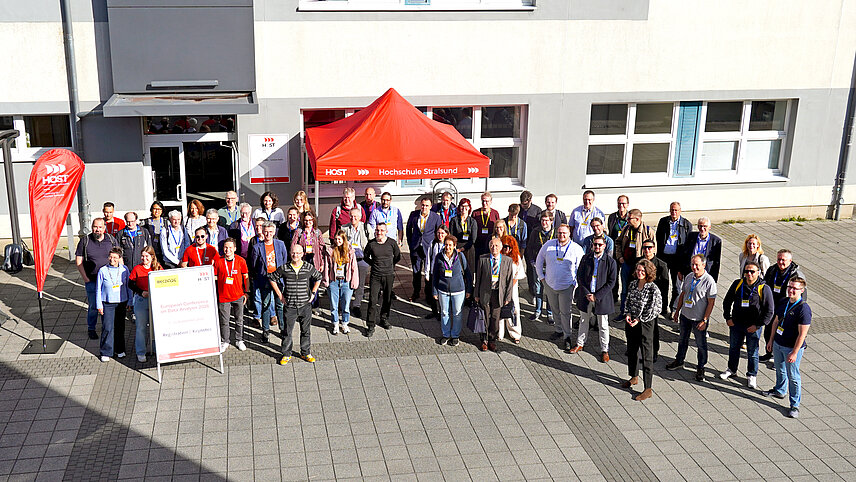 Photo: © Claudia Rahn/Hochschule Stralsund
Explaining how complex machine-learning models arrive at their predictions is a central challenge in data science. Shapley values have become a widely used tool for this purpose: They help estimate how much individual features contribute to a model’s prediction. But calculating them requires substantial computational effort, and the values alone do not show how certain these explanations are.
A new prediction algorithm developed by Prof. Marjolein Fokkema and her collaborators addresses both challenges. RuleSHAP enables Shapley values to be computed efficiently while also quantifying their uncertainty. This makes it possible to move beyond explaining individual predictions and use Shapley values for scientific inference.
Marjolein Fokkema presented the approach during her keynote at the European Conference on Data Analysis (ECDA 2026), held from September 9 to 11 at Stralsund University of Applied Sciences. Her talk, “Machine-learning based discovery and inference: Combining Bayesian regression, tree ensembles and Shapley values,” brought together several strands of her research on machine learning, interpretability, and statistical inference.
From prediction to scientific understanding
The work reflects a central question in Marjolein Fokkema’s research at the Chair of Computational Statistics with Applications in Psychology at TU Dortmund University and RC Trust: How can researchers obtain reliable scientific knowledge from powerful machine-learning models?
Uncertainty quantification plays an important role in this process. Knowing which variables contribute to a prediction is useful. Knowing how much confidence researchers can place in these estimated contributions adds another layer of information that is essential when results are used to draw scientific conclusions.
RuleSHAP is being developed in collaboration with Giorgio Spadaccini, PhD researcher at Leiden University, and Prof. Mark van de Wiel of Amsterdam University Medical Center.
The topic also fits closely with the broader scope of ECDA. The international conference provides a forum for methodological and applied research in data science, bringing together perspectives from statistics, computer science, mathematics, psychology, and other application areas.
ECDA
ECDA 2026 attracted 105 submitted abstracts from 17 countries and featured around 30 thematic sessions. Marjolein Fokkema was one of six invited keynote speakers at this year’s conference.
Category
- Network
- Event
- Computational Statistics with Applications in Psychology
Author
Patrick Wilking