14.09.2026
Nils Weitzel showed at Statistische Woche 2026 how statistics can reveal strengths and gaps in climate simulations.
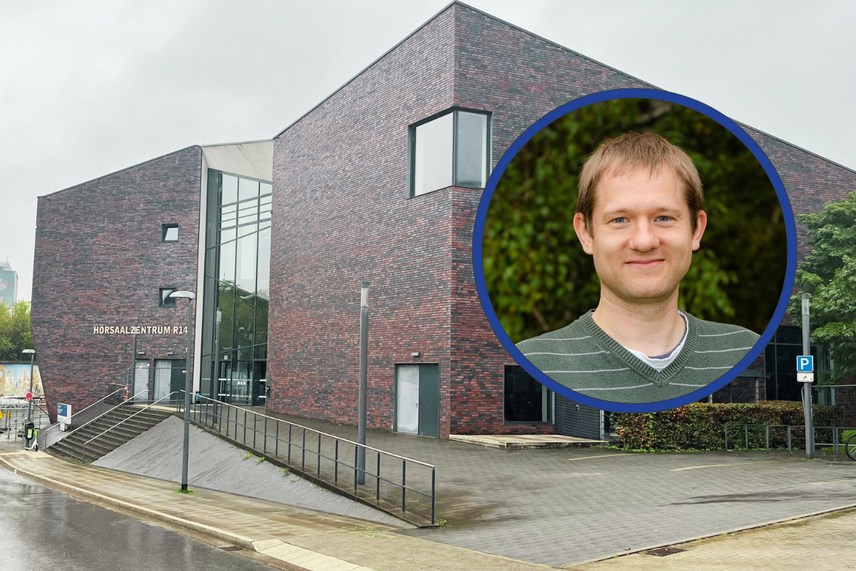
How well do climate models capture the way temperatures vary across regions and over time? Answering this question is essential when process-based models are used to explore how the Earth system may develop in the future. Junior Professor Nils Weitzel, who leads the Environmetrics research group at RC Trust and TU Dortmund University, addressed this challenge as an invited speaker at Statistische Woche 2026 in Essen. His talk, Inferring the spatio-temporal structure of climate variability from observations, simulators, and reconstructions of past climate, examined how statistical methods can bring together different sources of climate information.
The challenge is substantial. The climate system is high-dimensional and chaotic, with variations ranging from minutes to millions of years. At the same time, researchers need to work with heterogeneous sources of evidence: modern observations provide detailed information for only the last two centuries, while knowledge of older periods increasingly depends on natural archives and becomes more sparse and uncertain further back in time.
Where global agreement meets regional differences
In his presentation, Nils Weitzel introduced two complementary statistical frameworks for comparing climate simulations with temperature reconstructions from natural archives such as sediment cores. The comparison reveals an important distinction. For global mean temperature, simulations and reconstructions are consistent across timescales ranging from one year to hundreds of thousands of years. At the regional level, however, discrepancies emerge. According to the research presented, these differences suggest that the spatial covariance structure of current climate simulators may be misspecified on multidecadal and longer timescales.
In other words, state-of-the-art climate models can reproduce the global picture while still missing important regional heterogeneity.
Making uncertainty part of the analysis
To better understand these differences, Nils Weitzel presented a Bayesian hierarchical framework for reconstructing climate patterns across space and time from sparse and noisy temperature proxies. The approach combines information about local relationships between proxy data and climate with statistical models of how climate evolves over time and across regions. It was illustrated using simulation studies and temperature reconstructions derived from pollen assemblages.
This is also where the research connects closely to trustworthy data science. Uncertainty is not treated as something to hide, but as something that needs to be quantified and incorporated into the analysis. The long-term aim is to use statistical postprocessing methods to transfer insights from climate field reconstructions into refined regional temperature projections for the coming centuries.
Statistics across disciplines
Statistische Woche 2026 took place in Essen from September 8 to 11. The conference brought together a broad range of statistical fields, from methodological research and data science to economic, regional, and environmental applications. With over 250 participants, it is one of the leading statistics conferences in Germany bringing together University researchers and practitioners.
Category
- Talk
- Network
- Event
- Staff
- Environmetrics
Author
Patrick Wilking