13.02.2026
Paula Ebner explores emotional bonds with AI on Safer Internet Day.
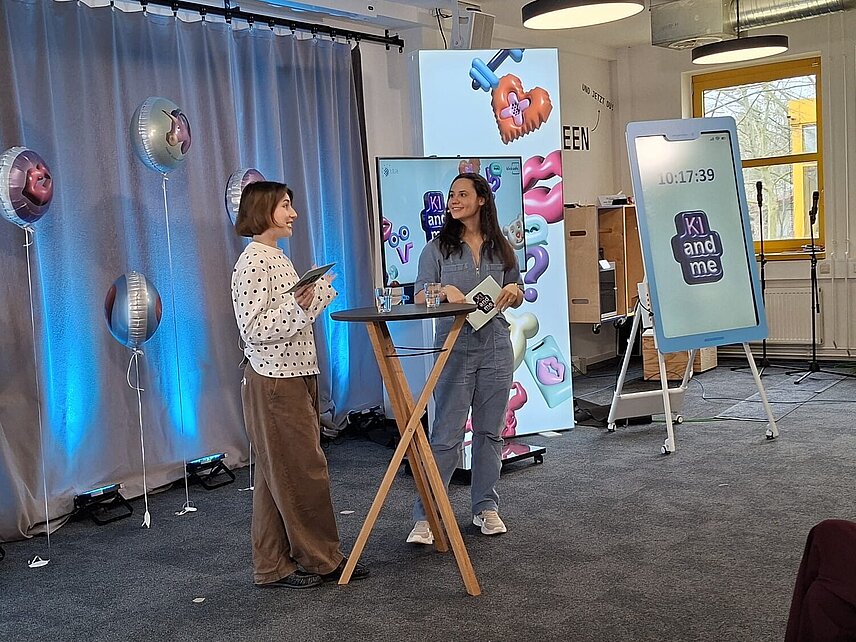 Photo: klicksafe/Axel Heiter
More than 50,000 students gathered online at 10 a.m. on February 10 to take part in the nationwide klicksafe school session marking Safer Internet Day 2026. Under the motto KI and me. In künstlicher Beziehung, classrooms across Germany – and even beyond – engaged in a shared reflection on how artificial intelligence is reshaping human relationships.
At the center of this conversation was social psychologist Paula Ebner from the University of Duisburg-Essen. As a PhD researcher in the interdisciplinary group Intimacy with and through Technology (INTITEC), led by Dr. Jessica Szczuka, she brought current research on human–chatbot relationships into a space where it matters most: young people’s everyday digital realities.
Her message was clear, nuanced, and timely. Emotional attachment to AI systems is neither irrational nor rare. “Many companion bots are deliberately designed to create a feeling of closeness and connectedness,” Ebner explained. From a psychological perspective, it is entirely understandable that users develop emotional bonds with artificial agents. Our brains rely on learned social scripts, and we tend to apply them automatically–even to technologies that simulate empathy and intimacy.
Yet the event did not stop at fascination. Ebner also emphasized critical awareness. Behind every chatbot, she reminded the audience, stands a company with economic interests. Emotional closeness, time spent interacting, and the data users disclose are not neutral byproducts–they are part of a larger digital ecosystem shaped by platform design, gamification, and commercialization. Maintaining agency, especially in moments of emotional vulnerability, is therefore essential.
The interactive format of the klicksafe school session ensured that young voices were not only addressed but actively included. Questions from the klicksafe Youth Panel and the Youth Advisory Board of the Federal Agency for Child and Youth Media Protection, as well as live polls during the session, highlighted how present AI companions already are in students’ lives. In the subsequent “Inside Talk,” young participants discussed opportunities and boundaries of AI with invited experts, underlining both curiosity and critical reflection.
Ebner’s contribution reflects the broader research agenda of INTITEC. The group investigates how conversational agents and generative AI transform intimacy, authenticity, and trust. Their work challenges simplified narratives–such as the idea that loneliness alone drives engagement with AI companions–and instead identifies complex psychological motivations, attachment styles, and design factors that shape digital relationships. At the same time, the research addresses questions of privacy, power, and responsibility, recognizing that emotional vulnerability and data exposure are closely intertwined.
Safer Internet Day 2026 thus became more than a single awareness event. It served as a bridge between cutting-edge research and everyday digital practice. By translating empirical findings into accessible insights, Paula Ebner contributed to a public conversation that connects psychological science, ethical reflection, and societal responsibility.
In a world where artificial agents can simulate empathy and companionship, the question is no longer whether relationships with AI exist–but how we understand, regulate, and shape them.