29.05.2026
Meltem Aksoy discussed calibrated trust in AI education at HAYEF AI4EDU 2026.
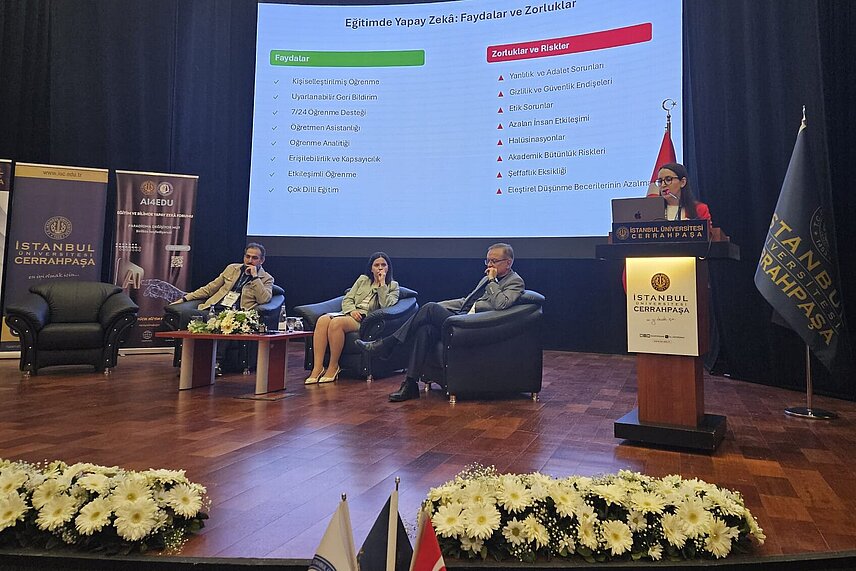 Photo: Meltem Aksoy at HAYEF AI4EDU 2026
Artificial intelligence is already changing the way people learn. It can help draft texts, summarize complex materials, generate exercises, support feedback processes, and open new ways of accessing knowledge. For schools and universities, this creates enormous opportunities – but also a difficult question: How much should we trust AI in education?
This question cannot be answered by technology alone. Education is about people, responsibility, fairness, and the ability to understand how decisions are made. If AI systems are used to support learning, teaching, assessment, or academic work, they must be more than powerful. They must be transparent, fair, ethically grounded, and used with a clear understanding of their limits.
This was the perspective brought in by Dr. Meltem Aksoy, Postdoc at the Research Center Trustworthy Data Science and Security (RC Trust), during HAYEF AI4EDU 2026 in Istanbul.
A multidisciplinary forum in Istanbul
Held on May 16, 2026, and organized by Istanbul University-Cerrahpaşa, HAYEF AI4EDU 2026 brought together academics, educators, researchers, technology experts, and students to discuss how artificial intelligence is reshaping education. Under the guiding question “Is Artificial Intelligence Changing the Educational Paradigm?”, the forum addressed AI not only as a technical development, but as a social, ethical, and pedagogical challenge.
With more than 1,000 participants, the event created space for invited talks, panels, workshops, and academic sessions. Its strength lay in connecting different perspectives: those who develop AI systems, those who study their social implications, and those who face their effects directly in educational practice.
Meltem Aksoy on calibrated trust
As part of the panel “Artificial Intelligence in Education (2W2H)”, Meltem Aksoy gave a presentation titled “Trustworthy Artificial Intelligence: New Horizons in Education.” Her contribution focused on trust in AI systems, transparency, fairness, ethics, and responsible AI practices in educational settings.
A central idea of her talk was calibrated trust. In the context of AI, this means avoiding two equally problematic extremes: blindly relying on AI systems on the one hand, and rejecting them altogether on the other. Instead, users need to understand what an AI system can do, where it may fail, and when human judgment must remain decisive.
For education, this distinction is particularly important. A tool that supports learning can be helpful; a tool that silently shapes assessment, feedback, or access to opportunities without transparency can become problematic. Trustworthy AI in education therefore requires more than technical accuracy. It requires explainability, responsible design, and informed use.
Why trust matters in learning
The classroom, whether physical or digital, is a sensitive space. Decisions made there can influence confidence, participation, educational pathways, and future opportunities. If AI systems become part of that environment, their role must be carefully examined.
Who understands the basis of an AI-generated recommendation? How are biases detected and addressed? Can students and teachers question the output of a system? And how can institutions make sure that AI supports learning rather than replacing the human relationships at the center of education?
These questions show why trustworthy AI is not an abstract research concept. It directly affects how societies organize knowledge, opportunity, and responsibility. In education, the goal should not be to automate as much as possible. The goal should be to use AI where it genuinely supports people – and to remain cautious where it may obscure, simplify, or distort complex human contexts.
Connecting research, ethics, and practice
Meltem Aksoy’s contribution in Istanbul reflects a broader understanding of the RC Trust’s mission. Trustworthy AI is not only about building better algorithms. It is also about asking how AI systems behave in real-world environments, how people interact with them, and what kind of safeguards are needed when technology enters sensitive areas of society.
By bringing questions of transparency, fairness, ethics, and calibrated trust into a forum on AI and education, Aksoy helped connect technical research with educational practice and societal debate. This is where the topic becomes especially relevant: AI in education will not be shaped by technology alone, but by the way researchers, educators, policymakers, and students negotiate its role.
For the RC Trust, this discussion is central. Trustworthy AI must work not only in controlled research settings, but in the places where people learn, make decisions, and prepare for the future. In that sense, the question is not simply whether AI is changing education.
The more important question is whether education can shape AI responsibly.
Category
- Talk
- Network
Author
Patrick Wilking