30.01.2026
At the AI Colloquium, JProf Nils Weitzel presents Environmetrics for trustworthy climate insights.
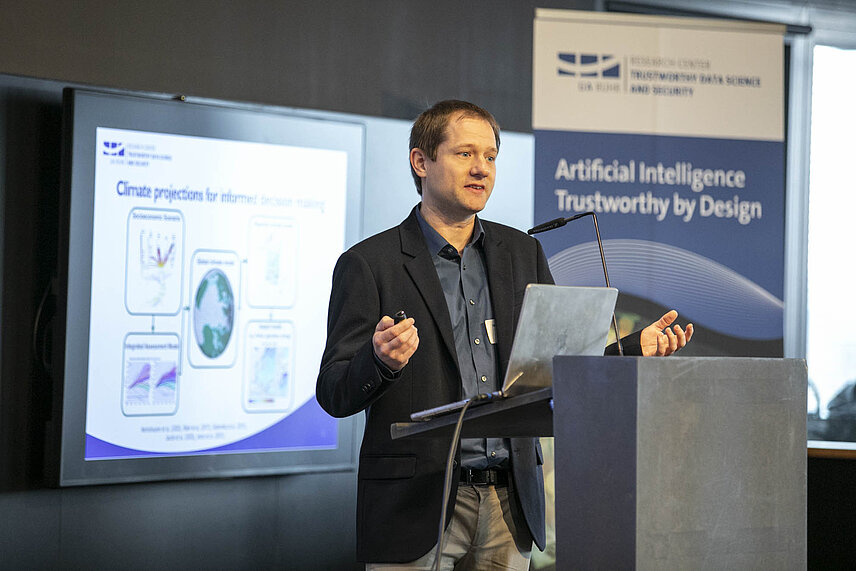 Photo: RC Trust
Environmental change increasingly shapes political, economic, and societal decisions - from climate adaptation and infrastructure planning to risk assessment and long-term policy strategies. The central challenge is no longer whether data matter, but how reliably heterogeneous environmental data and scientific process understanding can be combined to support trustworthy, evidence-based decision-making.
In his talk Environmental data, Earth system variability, and data-constrained future projections – research agenda of the Environmetrics group, JProf. Nils Weitzel introduces the research agenda of his newly established Environmetrics group at TU Dortmund University and the Research Center Trustworthy Data Science and Security (RC Trust). Environmetrics is a subdiscipline of statistics dedicated to the analysis of environmental and climate data - spanning a wide range of data types, from satellite observations and instrumental measurements to natural archives such as sediment cores, fossil pollen, or records of animal abundance.
A defining challenge in this field is the absence of controlled real-world experiments. As a result, robust scientific inference requires the integration of multiple data sources and simulations with complex, process-based numerical models. In his lecture, Weitzel will provide an overview of this research landscape before presenting current work on the spatio-temporal structure of climate variability - a key feature emerging from the interaction of external forcing and internal Earth system dynamics.
By combining instrumental observations, natural climate archives, and climate model simulations, his research shows that state-of-the-art climate models successfully reproduce global mean temperature variability across timescales, but systematically underestimate regional climate variability on multi-decadal and longer timescales. This finding points to a misrepresentation of the spatial structure of climate variability in existing models, with potentially far-reaching consequences for projections of future regional climate change and associated risk assessments.
In the final part of the talk, Weitzel will outline additional research topics currently pursued by the Environmetrics group and discuss future directions. These include improving Earth system projections by incorporating new constraints from past environmental changes and identifying opportunities for interdisciplinary collaboration.
Event details
📅 Date: 4 February 2026
⏰ Time: 10:30–11:30 AM
💻 Online participation via Zoom:
tu-dortmund.zoom.us/j/92778021899
Meeting ID: 927 7802 1899
Code: 793838
AI Colloquium
The AI Colloquium is a series of lectures dedicated to cutting-edge research in the field of machine learning and artificial intelligence, coorganized by the Research Center Trustworthy Data Science and Security (RC Trust), the Lamarr Institute for Machine Learning and Artificial Intelligence (Lamarr Institute), and the Center for Data Science & Simulation at TU Dortmund University (DoDas).
Graduate School
The lecture is also part of the Graduate School programme, which offers early opportunities for independent research, close supervision, and access to a strong interdisciplinary and international network. With flexible structures and individual guidance, it provides an inspiring environment for developing original research directions.
Category
- Talk