16.06.2026
An award-winning EDIH-DO transfer project, jointly shaped by Stattküche GmbH and Markus Pauly’s group, shows how AI and statistics can help reduce food waste.
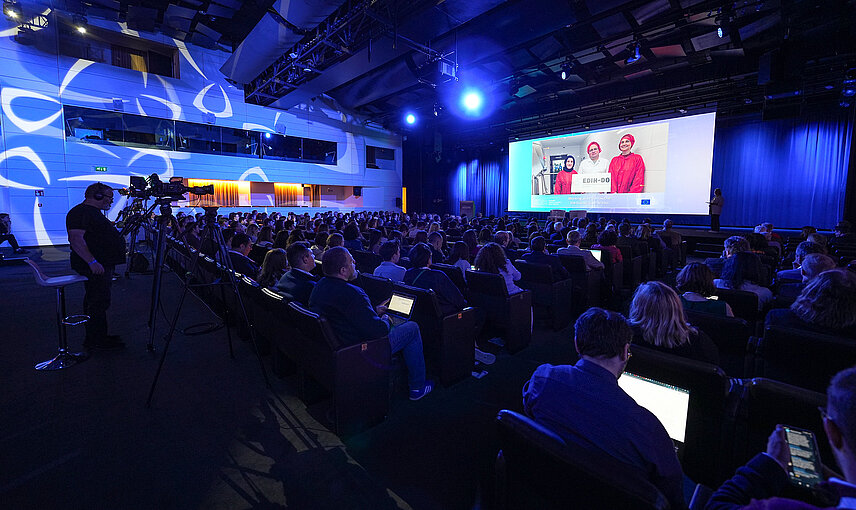 Photocredit: European Digital Innovation Hubs Network
The European Digital Innovation Hub Dortmund (EDIH-DO) has won the EDIH Network Award for Excellence 2026 for a project that begins with a very everyday problem: food that is cooked, delivered, but never eaten.
The award was presented at the EDIH Summit in Brussels, where the transfer project “AI Instead of Waste” was selected from 69 submissions from across Europe. For EDIH-DO, the recognition highlights the international relevance of digital innovation made in Dortmund and the region. For the project partners, it shows how artificial intelligence and statistics can create practical value far beyond the laboratory.
At the center of the project is a concrete challenge from school and kindergarten catering. Stattküche GmbH, a Münster-based company that has been supplying freshly cooked lunches to schools and kindergartens for more than four decades, currently produces around 22,000 portions every day. A share of pre-ordered meals is not collected because cancellations are made too late or forgotten. For hygiene reasons, these meals often have to be discarded.
That makes food waste not only an environmental problem, but also a planning problem.
AI for more precise planning
“AI Instead of Waste” addresses this challenge by making meal planning more data-driven. The goal is to align production more closely with actual demand while keeping the flexibility families need in everyday life.
To this end, the project translated Stattküche’s operational challenge into an AI-based forecasting approach that helps predict expected cancellations more accurately. The approach was developed by Dr. Ina Dormuth under the supervision of Prof. Markus Pauly in close collaboration with Stattküche’s domain experts and within the EDIH-DO project partnership involving TU Dortmund University and the Centrum für Entrepreneurship & Transfer (CET). The project used historical order data, prepared and analyzed it, and combined it with contextual information such as holidays, weather conditions, and flu-wave data. Several statistical and machine learning approaches were tested to identify models that could support daily planning in a practical way.
The result is not a distant research prototype, but a tool designed for operational use: documented notebooks and automated data preparation routines that allow Stattküche to analyze historical patterns and support future portion planning. Quantitative long-term evidence on waste reduction is still being collected, but the system has already been integrated into daily workflows and supports more transparent, data-informed decisions.
A European hub for digital transformation
EDIH-DO is the European Digital Innovation Hub Dortmund. It supports small and medium-sized enterprises as well as public-sector organizations in applying digital technologies and artificial intelligence to real-world challenges. As an EU co-funded initiative, EDIH-DO can provide its services to companies and public institutions free of charge. Through projects like “AI Instead of Waste”, the hub helps companies move from interest in digitalization to concrete implementation.
The award therefore recognizes more than one technical solution. It acknowledges a transfer model: companies bring practical challenges, digital innovation hubs provide guidance and infrastructure, and scientific partners contribute methodological expertise.
At TU Dortmund University, this transfer environment is shaped by project partners including the Centrum für Entrepreneurship & Transfer (CET), which is part of TU Dortmund University and serves as the university’s central point of contact for transfer and start-up support on campus. Together with EDIH-DO, TU Dortmund University and CET help connect companies with scientific expertise and practical support for digital innovation. The project shows how this kind of ecosystem can support innovation that is both technologically meaningful and socially relevant.
Statistical expertise from TU Dortmund University
The scientific contribution came from Prof. Markus Pauly’s group at the Department of Statistics. Much of the statistical modeling, data preparation, and implementation work was conducted by Dr. Ina Dormuth under Pauly’s supervision, in close exchange with Stattküche’s domain experts. This collaboration ensured that the AI-based approach was not only methodologically sound, but also aligned with the operational realities of daily meal planning.
Markus Pauly is Principal Investigator at the Research Center Trustworthy Data Science and Security (RC Trust) and professor at the Department of Statistics at TU Dortmund University, where he leads the Chair of Mathematical Statistics and Applications in Industry. Dr. Ina Dormuth, a former PhD student and postdoc in his group, carried out the main analytical work on the project during her time as a postdoc there. Since 2026, she has been working as a Data Scientist in R&D at Wilo Group.
Their role was not to turn food planning into an abstract AI experiment. It was to help develop a methodologically sound and usable approach for a real operational problem: how to learn from past order and cancellation patterns, how to compare different forecasting methods, and how to make the results useful for people who plan meals every day.
This is where the project becomes particularly relevant for trustworthy data science. Trustworthy AI is not only about high-performance models. It is also about whether data is accessible, assumptions are transparent, results can be interpreted, and tools can be used responsibly in everyday decision-making.
From food waste to trustworthy data science
“AI Instead of Waste” shows how artificial intelligence can become valuable when it is embedded in a clear problem, a strong partnership, and careful statistical work. The project does not claim that AI can solve food waste on its own. Instead, it demonstrates something more credible: with good data, practical expertise, and robust methods, waste can become more predictable – and what becomes predictable can often be reduced.
For RC Trust, the project is a strong example of how trustworthy data science can contribute to sustainability. The application may be school catering, but the underlying question reaches much further: How can data-driven systems support better decisions in real-world processes without losing sight of transparency, usability, and responsibility?
The EDIH Network Award for Excellence 2026 gives this question international visibility. It recognizes a Dortmund-based transfer project that connects European digital innovation, regional cooperation, statistical research, and a problem that everyone can understand: less food should end up in the bin.
Category
- Award