08.07.2026
At RC Trust, Julian Rodemann discussed feedback loops, uncertainty, and the communication of reliable data science.
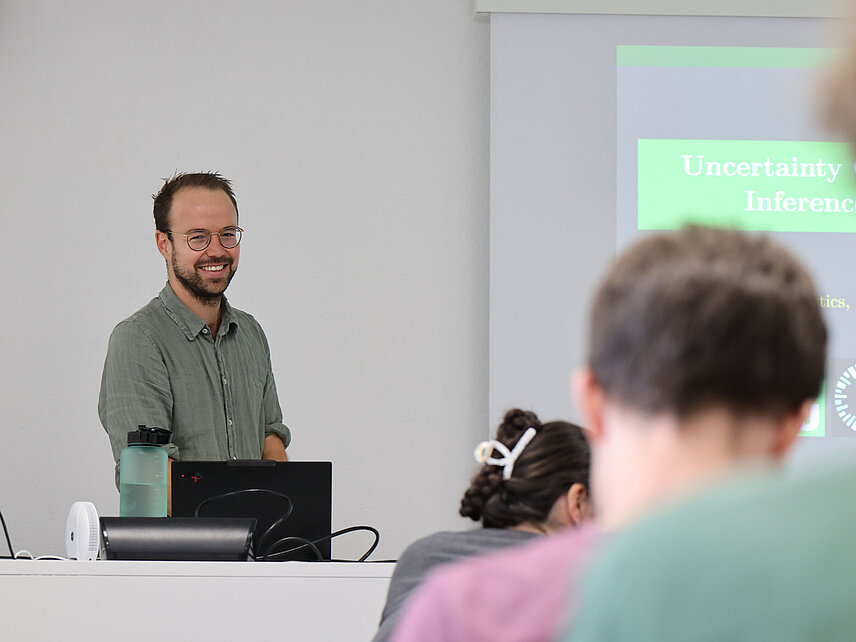 Photo: Julian Rodemann
A traffic forecast that prevents the traffic jam it predicted. A generative model trained on texts or images that the model itself has produced. A credit-scoring system whose users learn how to adapt their behaviour to the classifier. These are not just clever examples. They point to a fundamental challenge for modern data science: models do not merely observe the world. Increasingly, they become part of the world they are meant to analyse.
This was the starting point of a guest talk by Dr. Julian Rodemann at RC Trust on July 3. Under the title Uncertainty Quantification and Statistical Inference Under Feedback Loops, Rodemann explored how uncertainty can still be measured, interpreted, and communicated when models, data, and real-world behaviour influence each other.
Rodemann is a postdoctoral researcher in statistical learning at the Rational Intelligence Lab at CISPA Helmholtz Center for Information Security in Saarbrücken. He is also affiliated with the Department of Statistics at Ludwig-Maximilians-Universität München, where he obtained his PhD in statistics. His research focuses on uncertainty quantification, online learning theory, decision theory, interpretable machine learning, Bayesian approaches, and imprecise probabilities. A central aim of his work is to make machine learning more reliable by representing the uncertainties involved.
At first glance, uncertainty may sound like a weakness. In science, however, it is often the opposite. Data science draws conclusions about something unknown – a population, a system, a future development – from limited observations, assumptions, and models. These conclusions are never simply certain. Quantifying uncertainty helps make visible how reliable they are. It prevents models from presenting their outputs as more definitive than they actually are.
For trustworthy data science, this is crucial. If uncertainty is high, a model should not be relied upon in the same way as when uncertainty is low. Trust, in this sense, is not blind confidence. It is calibrated reliance: the ability to judge when a model deserves confidence, when caution is necessary, and where further evidence is needed.
Rodemann’s talk showed why this task becomes harder in many modern applications. Classical statistical reasoning often assumes that population, data, and model can be treated as separate entities: data are sampled from a population, a model is fitted, and conclusions are drawn. Yet in feedback loops, this separation can break down. Models may influence the data they learn from. Predictions may change the behaviour they predict. Learning systems may adapt their own samples over time.
One example is performative prediction. A navigation app may forecast congestion and suggest alternative routes. If enough people follow the recommendation, the predicted congestion may never occur. The prediction has changed the outcome. For statistical inference, this creates a difficult problem: once the model’s output enters the world, the world itself may no longer be the same.
But Rodemann did not frame feedback loops only as a risk. Under certain conditions, they may also become an opportunity. If systems are designed carefully, feedback mechanisms could help create incentives for communicating uncertainty more honestly. A simple example is strategic ambiguity: if credit applicants react to a bank’s credit scoring system, it may be in the bank’s own interest to communicate uncertainty about that system. This can make it harder for applicants to “game” the system, simply because they do not know for sure which model is being used. In other words, the challenge is not only to develop mathematical methods for uncertainty quantification. It is also to ask whether researchers, institutions, and model providers have reasons to use and communicate them.
This is where Rodemann’s background adds another dimension. Before his academic career, he worked as a data journalist – an experience that shaped his view of uncertainty communication. Scientific communication often faces a tension: audiences need orientation, but orientation should not become false certainty. Readers may want clear facts, yet good science often requires explaining what is known, what remains open, and how reliable a conclusion is.
The point is not to overwhelm people with caveats or percentages. Nor is it to hide uncertainty behind simplified claims. The more difficult task is to make uncertainty understandable and useful.
At RC Trust, this question sits at the heart of interdisciplinary research on trustworthy data science and security. Trustworthy systems are not built by eliminating uncertainty. They are built by recognizing it, quantifying it, communicating it, and designing systems that help people act responsibly in its presence.
Further reading
For readers interested in the research behind the talk, Julian Rodemann highlighted the following papers:
Generalization Bounds and Stopping Rules for Learning with Self-Selected Data
Julian Rodemann and James Bailie https://arxiv.org/pdf/2505.07367
Performative Learning Theory
Julian Rodemann, Unai Fischer-Abaigar, James Bailie, and Krikamol Muandet https://arxiv.org/abs/2602.04402
Off-Policy Evaluation with Strategic Agents via Local Disclosure
Kiet Q. H. Vo, Abbavaram Gowtham Reddy, Julian Rodemann, Siu Lun Chau, and Krikamol Muandet https://arxiv.org/abs/2606.07308
Reciprocal Learning
Julian Rodemann, Christoph Jansen, and Georg Schollmeyer https://proceedings.neurips.cc/paper_files/paper/2024/file/0337b41b4e8b2eb5d7ab161ffd42cf3b-Paper-Conference.pdf
Category
- Talk
Author
Patrick Wilking