03.06.2026
Linara Adilova presented RC Trust research at a BIFOLD and ELLIS workshop on AI-driven scientific understanding.
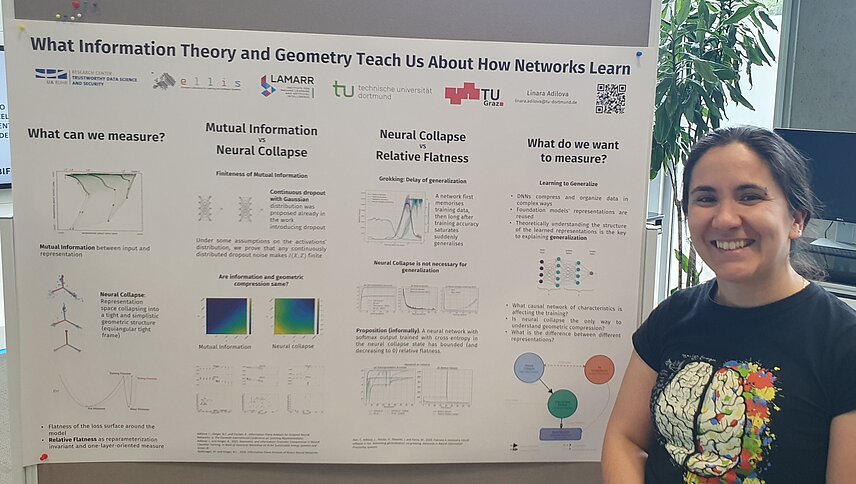 Photo: Linara Adilova
How can artificial intelligence help science move beyond prediction and toward deeper understanding? This question was at the center of the workshop AI to Accelerate Scientific Understanding, hosted by the ELLIS Unit Berlin and BIFOLD – the Berlin Institute for the Foundations of Learning and Data.
The workshop brought together researchers from machine learning and a wide range of scientific disciplines to explore how explainable and interpretable AI can support scientific discovery. Through invited talks, poster sessions, tutorials, and interdisciplinary discussions, participants addressed applications in areas such as molecular science, medicine, geoscience, social science, digital humanities, and neuroscience. A central focus was the question of how AI systems can become more than powerful prediction tools: how they can help researchers understand the structures, mechanisms, and patterns behind scientific phenomena.
Dr. Linara Adilova, Junior Research Group Leader at TU Dortmund University and the Research Center Trustworthy Data Science and Security (RC Trust), contributed to the workshop with a poster presentation on her research. Under the title What Information Theory and Geometry Teach Us About How Networks Learn, she presented work on the properties of latent representations in neural networks and their connection to the generalization abilities of deep learning models.
This perspective connects closely to the research agenda of RC Trust. Trustworthy AI depends not only on performance, but also on a better understanding of why models behave the way they do. In deep learning, this includes the question of why neural networks can generalize from training data to unseen examples, and how their internal representations change during learning. Linara’s work approaches this challenge through concepts from information theory and geometry, including mutual information, neural collapse, and relative flatness.
Her poster was based on collaborative work with researchers from Ruhr University Bochum, Lamarr, and Graz University of Technology, including Dr. Henning Petzka, Prof. Asja Fischer, Prof. Michael Kamp, Ting Han, and Prof. Bernhard C. Geiger. The presentation therefore also highlighted the broader research networks in which RC Trust is active – connecting theoretical foundations of deep learning with current debates on explainability, interpretability, and scientific discovery.
By bringing this work into an interdisciplinary BIFOLD and ELLIS setting, Linara contributed a fundamental perspective to a timely question: if AI is to accelerate scientific understanding, researchers also need to understand AI itself.
Category
- Network
- Event
- Staff
Author
Patrick Wilking