20.11.2026
At the Niederrheinische IHK, Nicole Krämer discussed how academia and business can work together to promote the responsible use of AI.
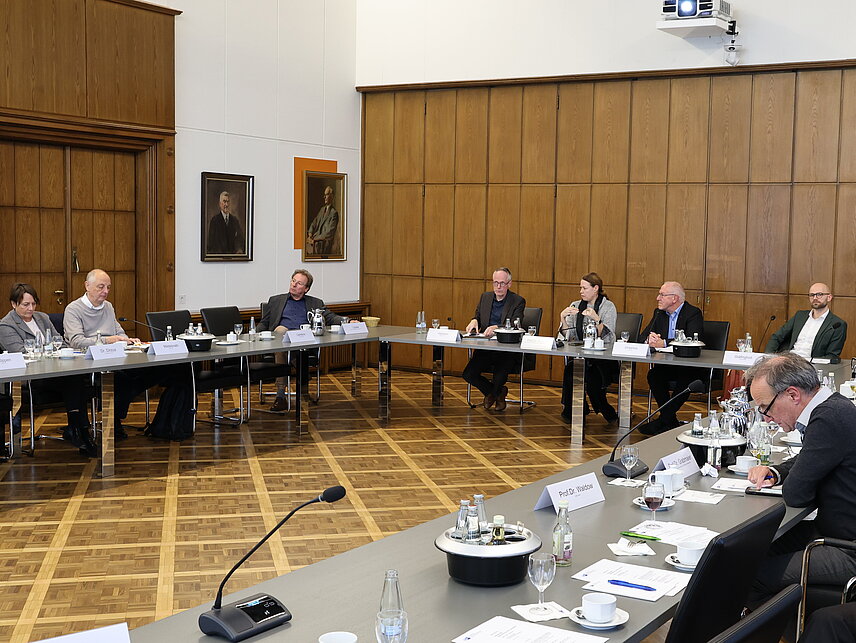 Photo: Nicole Krämer at the Niederrheinische IHK's Committee for Digitalization and Innovation © Patrick Wilking
Businesses have always been accustomed to responding to competitors and adapting to new developments. This is how they remain competitive and secure their economic success. However, the increasing pace of technological development poses new challenges, particularly for small and medium-sized businesses.
How businesses can adapt to these changes and what role artificial intelligence plays in this process was one of the topics discussed at the meeting of the Niederrheinische IHK's Committee for Digitalization and Innovation on November 10, 2026, in Duisburg. The committee brings together business leaders and representatives from academia and public institutions.
One of the central observations at the meeting was that artificial intelligence is changing business models, workflows, and services. This creates new opportunities for many businesses. At the same time, uncertainty is growing about the long-term impact AI will have on existing business models.
Seeking to make informed decisions for the future, the committee members entered into a dialogue with Prof. Nicole Krämer, Director of the Research Center Trustworthy Data Science and Security (RC Trust). During the discussion, Krämer emphasized that technological progress alone is not enough to make AI systems trustworthy. The human perspective and the ability to use AI competently are equally important: How do people perceive the technology, when do they trust it, and how does it influence their decisions? At RC Trust, technical and social science research provide the foundation for understanding and using AI. A central concept is Calibrated Trust: People should neither trust AI blindly nor reject it outright, but rather be able to assess its capabilities and limitations appropriately and competently.
Questions from Practice
The subsequent discussion demonstrated how relevant this research is to businesses and society. Committee members were interested, among other things, in whether AI systems can verify the results of other AI applications and what role independent consumer protection could play. The possibility of introducing a type of "AI certification seal" was also discussed. Such a seal could help businesses and consumers better assess the reliability of AI systems and their compliance with data protection requirements.
Other topics included dealing with AI-generated images, the reliability of automated search engine summaries, and the teaching of AI skills in schools and vocational training. This also raised the question of how training content needs to adapt to technological change and what skills people will need when working with AI in the future.
The exchange gave both sides an opportunity to compare scientific questions with practical challenges and identify potential areas for further dialogue.
Digitalization Remains an Important Topic for the IHK
The upcoming IT-Sicherheitstag NRW also demonstrates the IHK's continued interest in digitalization and IT security. On December 8, 2026, the Chambers of Industry and Commerce in North Rhine-Westphalia, together with DIGITAL.SICHER.NRW, will provide information on current cybersecurity challenges and practical security measures for businesses at Landschaftspark Duisburg-Nord.
Category
- Network
Author
Patrick Wilking