11.03.2026
Nicole Krämer discusses consumer implications of AI chatbots at NRW ministry event.
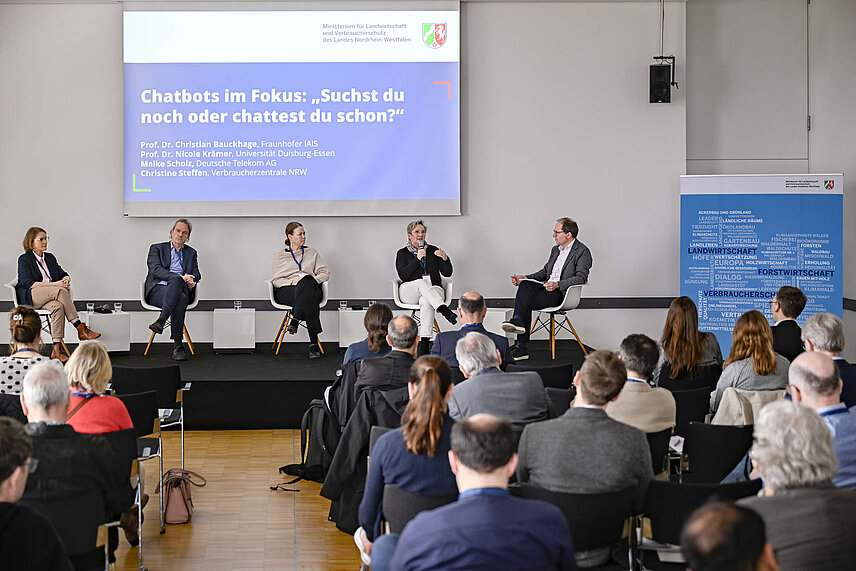 Photo: MLV NRW/Andreas Buck
Looking for information online often no longer begins with a search engine. Instead, many people now ask a chatbot for recommendations, comparisons or advice. Within seconds, AI systems can suggest options, evaluate services or help users make everyday decisions.
As artificial intelligence becomes increasingly integrated into everyday life, new questions arise about trust, transparency and consumer protection. These issues will be discussed on 12 March 2026 at the event Chatbot and AI Agent: (Not) a Friend and Helper?, hosted by the Ministry of Agriculture and Consumer Protection of North Rhine-Westphalia in Düsseldorf.
Among the invited experts is Prof. Nicole Krämer, Scientific Director of the Research Center Trustworthy Data Science and Security (RC Trust) and Professor of Social Psychology at the University of Duisburg-Essen. The event will bring together representatives from government, consumer protection organisations, academia and industry to examine how artificial intelligence is transforming everyday interactions with digital systems and what this means for policy and regulation. The discussion will take place in the presence of Minister Silke Gorißen.
Krämer will participate in the panel discussion “Chatbots in Focus – Are you still searching or already chatting?”, where experts will explore the consequences of AI-driven communication for consumers in everyday situations. Topics will include the reliability of chatbot recommendations, the role of training data and algorithms, and which information consumers should receive when interacting with AI systems.
Drawing on her research in media psychology and human–AI interaction, Krämer will contribute insights into how people perceive and evaluate AI-generated advice. Her research examines how trust in automated systems develops when users seek guidance on everyday decisions, financial questions or contractual matters. At the same time, she highlights psychological risks that can arise when people overestimate the capabilities of AI systems or form parasocial relationships with conversational agents.
The panel will also address regulatory challenges related to transparency, data usage and potential manipulation in AI-mediated interactions. Participants will discuss whether existing legal frameworks – such as European AI regulation and consumer protection law – are sufficient to ensure that AI applications remain fair, transparent and reliable for users.
By contributing scientific expertise to this policy dialogue, Krämer’s participation illustrates how research at RC Trust informs debates on the societal implications of emerging digital technologies. Her engagement reflects the growing demand for interdisciplinary perspectives that connect psychology, artificial intelligence and consumer protection – and highlights the role of RC Trust in supporting evidence-based discussions on trustworthy digital systems in North Rhine-Westphalia and beyond.
Category
- Talk
- Network
Author
Patrick Wilking