15.07.2026
At XAI 2026, RC Trust researcher Meltem Aksoy presented a framework that traces how calibration data shape prediction intervals.
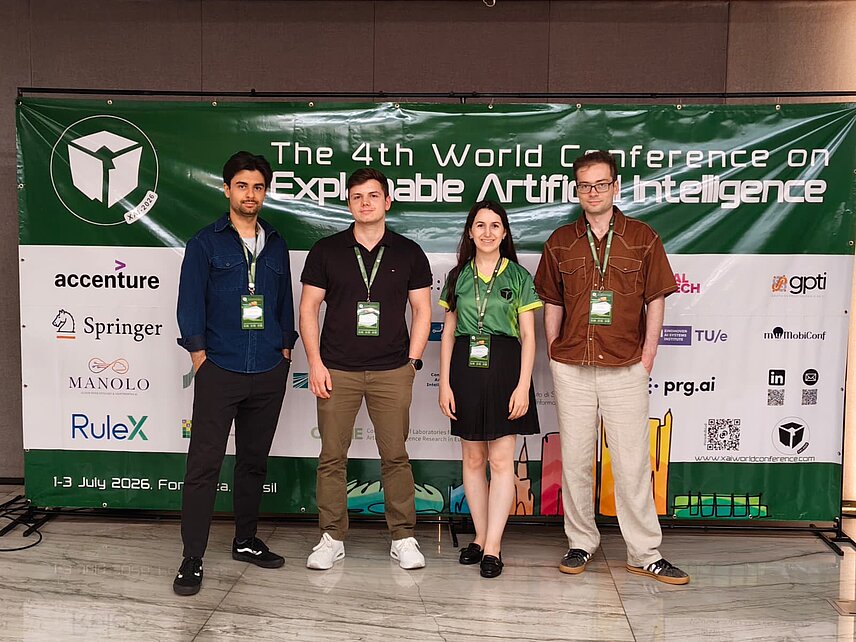 Photo: Meltem Aksoy
A prediction can be uncertain for different reasons. Some uncertainty reflects unavoidable variation in the data. Another part may arise because a model has learned too little about a case – or because its calibration combines observations that do not belong together. Conventional prediction intervals show only a range, without explaining what made it narrow or wide.
At the 4th World Conference on eXplainable Artificial Intelligence (XAI 2026) in Fortaleza, Brazil, RC Trust researcher Meltem Aksoy presented the paper ConformaDecompose: Explaining Uncertainty via Calibration Localization. The work introduces a framework that makes one source of predictive uncertainty more transparent: heterogeneous calibration data.
The research builds on conformal prediction, a model-agnostic method for adding prediction intervals to machine-learning outputs. Standard approaches calculate a threshold from an entire calibration dataset. This provides coverage guarantees, but can also combine data regions with different characteristics.
For an individual prediction, weakly related observations may therefore make the interval wider. ConformaDecompose examines this effect without retraining the model. It groups calibration examples according to their features, the model’s predictions and a measure of local model instability. Less relevant groups are then progressively downweighted.
Instead of returning only one interval, the framework traces how its width changes as calibration becomes more local. This reveals which calibration regions contribute to a wider interval, how much uncertainty can be reduced through localisation, and where the interval stabilises.
A case study using used-car listings illustrates the approach. For a relatively young, low-mileage and high-value vehicle, data from much older cars with high mileage increased the global interval. Once these less comparable market segments were downweighted, its width fell from approximately 4,855 to 4,545 US dollars–a reduction of around 6.4 per cent.
The researchers also evaluated the framework on four benchmark datasets from energy systems, healthcare, aeroacoustics and biology using two regression models. The absolute amount of reducible uncertainty was strongly associated with indicators of local model instability. Its relative contribution, however, varied between tasks.
The authors stress that ConformaDecompose is a diagnostic rather than a causal method. It does not directly separate true aleatoric and epistemic uncertainty. Its localised intervals are intended for explanation and do not carry the same coverage guarantee as the original global interval.
The paper was written by Fatima Rabia Yapicioglu of the University of Bologna and Automobili Lamborghini; Meltem Aksoy of RC Trust at TU Dortmund University; Alberto Rigenti of Automobili Lamborghini; Tuwe Löfström-Cavallin and Helena Löfström-Cavallin of Jönköping University; Şeyda Yoncacı of Haliç University; and Luca Longo of University College Cork.
About XAI 2026
Held from 1 to 3 July 2026, XAI 2026 was the fourth edition of a specialist conference devoted to explainable artificial intelligence. It brought together researchers and practitioners from several disciplines to discuss technical, human-centred, ethical and societal perspectives on making AI systems more understandable.
Category
- Publication
- Network
- Event
Author
Patrick Wilking