29.07.2026
Inês Terrucha presented RC Trust research in Japan on how delegating decisions to AI changes social behaviour – even when people retain full control over how the AI acts.
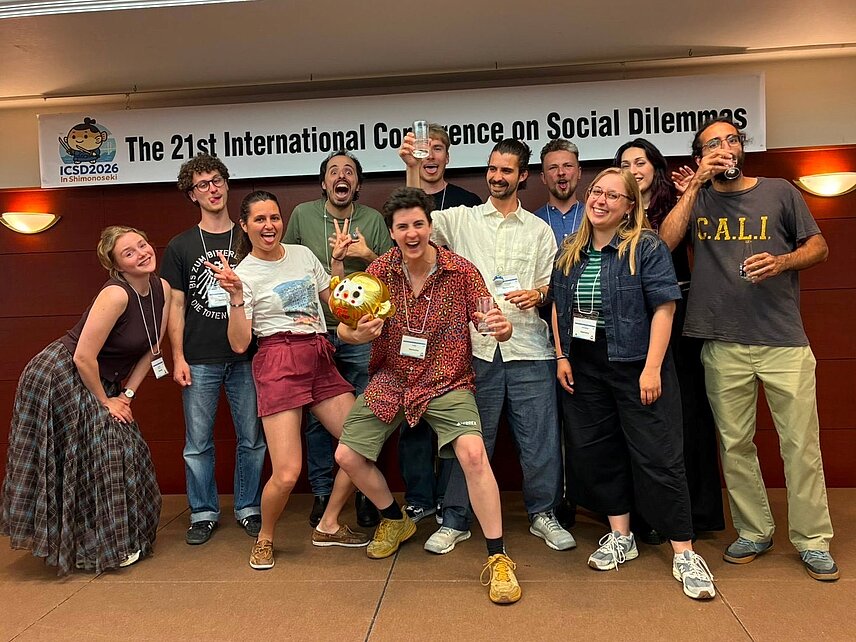 Photo: Inês Terrucha at ICSD 2026
Imagine a decision in which helping others comes at a personal cost. Now imagine handing that decision to an artificial intelligence. Does the machine make us more cooperative – or simply allow us to step away from responsibility?
Dr. Inês Terrucha explored this question at the International Conference on Social Dilemmas 2026 in Shimonoseki, Japan. The postdoctoral researcher from the Human Understanding of Algorithms and Machines group at RC Trust presented the study Delegation to artificial intelligence in social dilemmas, co-authored with Prof. Nils Köbis.
Letting AI choose
Social dilemmas arise when individual interests clash with what would benefit others or the group. They appear in laboratory games, but also in everyday questions surrounding shared resources, cooperation, climate action, and public life.
As AI systems increasingly assist or replace human decision-making, a new question emerges: What changes when people no longer make such choices themselves? In this research, delegation did not mean relinquishing control. Participants retained full agency: they defined the rules for rule-based agents, set the goals for goal-oriented agents, selected training datasets for learning-based agents, or crafted the prompts for LLM-based agents. Yet, remarkably, the mere act of delegating still appeared to shift their preferences or alter how they would act if they were making each choice themselves.
Terrucha and Köbis investigate this through a preregistered experimental program covering four established social dilemmas: the Dictator Game, the Prisoner’s Dilemma, the Snowdrift Game, and the Stag-Hunt Game. The research is designed to involve 3,200 participants.
Participants encounter three situations: deciding for themselves, being required to delegate to AI, and choosing whether to delegate. The study also compares different kinds of artificial agents – from rule-based systems to large language models.
Delegating cooperation – a game of strategy
The first results reveal a nuanced pattern: in the Dictator Game, delegating to AI increased prosocial choices compared to self-play. By contrast, in the Prisoner’s Dilemma, the Stag-Hunt Game, and the Snowdrift Game, delegation reduced cooperation rates. Most importantly, across all games, participants treated delegation as a payoff-driven strategy: they were more likely to delegate again when it had earned them more money, and less likely when self-play had been more profitable.
Delegation, the findings suggest, is not simply a stable preference for or against AI. It is shaped by experience and personal benefit – and the sheer act of delegation, even with full control over the agent’s behavior, appears to transform how people approach these dilemmas.
This distinction matters beyond experimental games. As AI systems take on a larger role in organizations and society, their influence will depend not only on what they decide, but also on why people entrust decisions to them. A system may encourage cooperation while simultaneously changing how responsibility, control, and self-interest are negotiated.
Terrucha’s research brings the human side of delegation into focus: AI does not enter an empty decision space. It enters situations already shaped by incentives, expectations, and competing interests – and the act of delegation itself, even when full control is retained by the user, can reshape behavior.
About ICSD 2026
The International Conference on Social Dilemmas took place from June 1 to 5, 2026, in Shimonoseki, Japan. The interdisciplinary conference brought together research from psychology, economics, sociology, political science, computer science, biology, and related fields. Its program addressed cooperation, trust, social norms, conflict, sustainability, human-machine interaction, and machine behavior.
Category
- Talk
- Network
- Event
- Staff
- Human Understanding of Machines and Algorithms
Author
Patrick Wilking