18.09.2026
Tuğrulcan Elmas joined the RC Trust Graduate School to examine who should know, decide, and act in human-AI interaction.
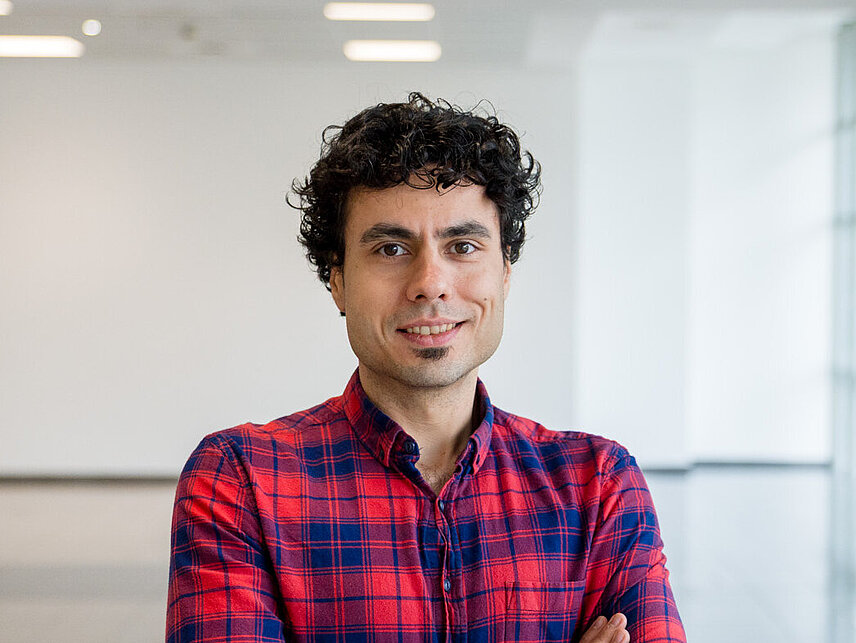 Tuğrulcan Elmas/Photo: @ Patrick Wilking
Conversational AI does more than answer questions. It can agree with us, challenge us, offer advice, and increasingly act on our behalf. People argue with it, seek reassurance, ask for advice, and sometimes hand over decisions or entire tasks. In these exchanges, facts are only part of what matters. Expectations, emotions, prior beliefs, and misunderstandings can shape the conversation as well.
This is where Tuğrulcan Elmas’ research begins. As an Assistant Professor in Computational Social Science at the University of Edinburgh, he studies how people interact with AI and how these systems influence information, judgment, and action. At the RC Trust Graduate School in Bochum, he approached the question through three deceptively simple prompts: Who should know? Who should decide? Who should act?
The visit also brought a reunion. RC Trust member Rebekah Overdorf and Elmas had worked together for several years at EPFL in Lausanne, including on research into retweet bots and manipulated trending topics. Their earlier work examined how online information can be manipulated; Elmas’ current research asks what happens when AI itself becomes part of the interaction.
The earth is flat!
Elmas used a deliberately simple example to introduce epistemic authority: What happens when a user tells an AI that the Earth is flat?
A model should not abandon a correct answer simply because a user disagrees. But an AI that refuses to revise itself when it is wrong is equally problematic.
Elmas and his colleagues studied how models respond when users challenge their answers. They found a clear distinction between social agreement and actual revision: models often validate users–apologizing or acknowledging an objection–while still maintaining essentially the same claim.
The challenge is deciding when AI should stand by an answer, reconsider it, or defer to human expertise.
Should I stay or should I go?
Relationship advice makes that question more personal.
If someone describes a difficult relationship, should an AI immediately recommend staying or leaving? Elmas presented research comparing AI-generated advice with discussions from Reddit’s relationship advice community.
His work points toward a different approach: asking further questions. A first account may leave out crucial context. Elmas therefore explored theory-guided “probing,” using concepts from relationship research to gather more information before producing advice.
Sometimes a productive AI response may begin not with an answer, but with another question.
Do my homework
Elmas’ third example came from his own teaching. He gave an AI agent the description and data for an assignment from his Computational Social Science course and asked it to complete the project.
When the result was graded without the marker knowing it had been produced by AI, it would have received the third-highest grade.
For Elmas, this exposes the problem of over-delegation. If an agent can complete the task, how can students remain responsible for the intellectual work? One approach he is exploring is guardrails that allow AI to assist while requiring students to direct the process.
The issue reaches beyond individual assignments. AI has effectively turned academic integrity into faculty’s second job: instructors increasingly face detection, evidence, appeals, and redesigned assessment without reliable tools or settled frameworks.
About Graduate School
The RC Trust Graduate School brings doctoral researchers together with scholars from different disciplines and institutions. Through talks and discussion, it creates space for interdisciplinary exchange, new methodological perspectives, and questions that extend beyond individual PhD projects.
Category
- Talk
- Network
- Event
Author
Patrick Wilking