Welcome to the Causality Group!
The chair of Causality was established in June 2024 and is led by Alexander Marx. We are part of the Department of Statistics at TU Dortmund University and affiliated with the Research Center Trustworthy Data Science and Security.
Our research focuses on causality and machine learning, with an emphasis on causal discovery, causal inference, and their connections to out-of-distribution generalization, representation learning, and information theory. We aim to enhance the trustworthiness, robustness, and generalization capabilities of AI systems by tackling fundamental challenges in data-driven decision-making. For more details, please check out our full list of publications.
Thesis Projects: If you are interested in the groups research, please feel free to contact us for a thesis project. Please attach your current transcript of records and a briev CV. We currently have some open topics on causal discovery via flexible regression (see, e.g., [1], [2] for inspiration), to investigate confounding (see FCI [3]), or potentially foundation models. Further, topics from our most recent seminars could also be suitable "Fairness and Causality Seminar" or "Topics in Bayesian Causal Inference". You can also propose your own topic. For inspiration, I would recommend to browse the most recent publications that are linked above.
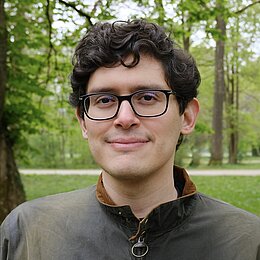
Dr. Javier Enrique Aguilar Romero
TU Dortmund University
Joseph-von-Fraunhofer-Straße 25
44227 Dortmund
Germany
05.08.2026
(c) Robin Stecher
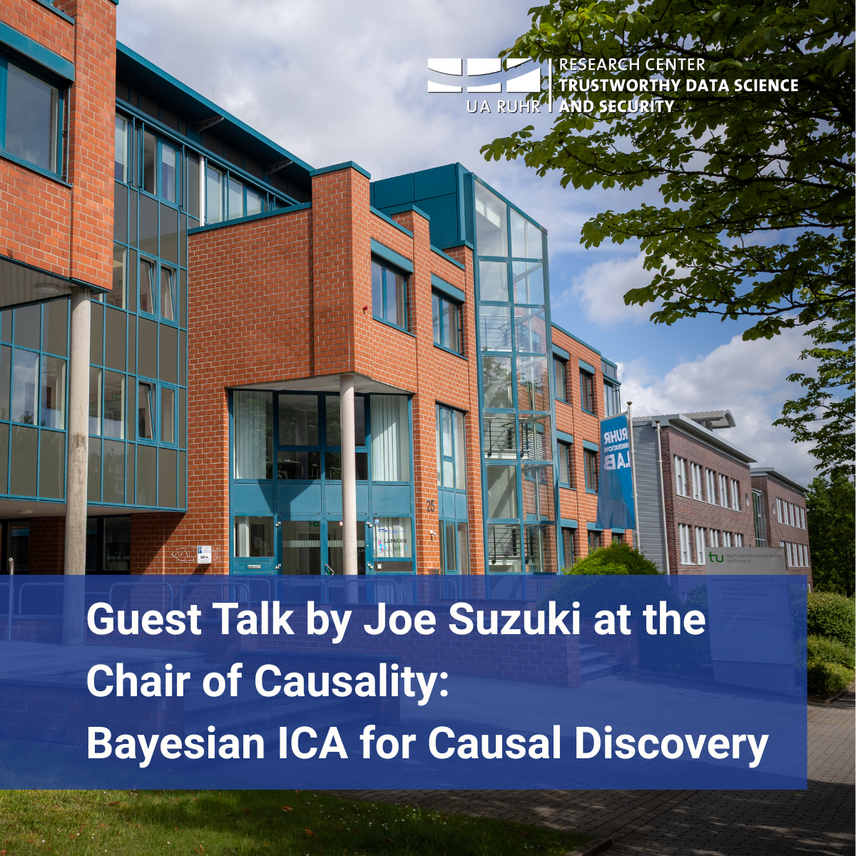
How can researchers decide which causal structure best explains observed data? In his guest talk, Joe Suzuki will present a Bayesian approach that considers not only how well a model fits the data, but also how complex it is.
Suzuki is a Professor Emeritus of Statistics at University of Osaka. He will visit the Chair of Causality, led by Prof. Alexander Marx at TU Dortmund University’s Department of Statistics and affiliated with the Research Center Trustworthy Data Science and Security (RC Trust), for a presentation titled “Bayesian ICA for Causal Discovery.”
Independent component analysis, or ICA, provides a framework for causal discovery when observed variables are generated from independent, non-Gaussian sources. Suzuki will discuss how this approach can be formulated within a Bayesian framework.
The central idea is to compare possible causal structures using their marginal likelihoods. This enables researchers to consider both model fit and model complexity. Suzuki will explain how Bayesian model selection can help identify causal orderings and dependency structures. He will also discuss computational strategies for reducing the number of possible structures that need to be examined.
Talk: Bayesian ICA for Causal Discovery
Speaker: Prof. Joe Suzuki, Division of Mathematical Science, Osaka University
Date: Monday, August 10, 2026
Time: 11:00 a.m.
Location: Joseph-von-Fraunhofer-Straße 25, Room 303
Online: Zoom
Patrick Wilking