10.06.2026
Markus Pauly joins the Scientific Programme Committee of the 73rd Biometrical Colloquium.
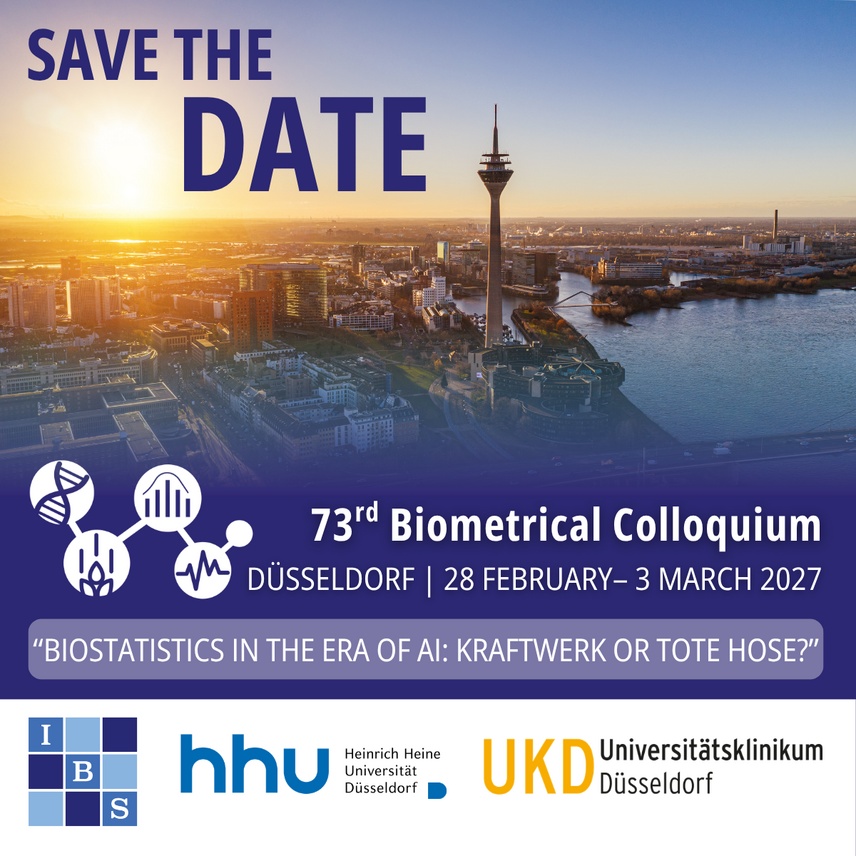 Credit: 73rd Biometrical Colloquium
Credit: 73rd Biometrical Colloquium
Credit: 73rd Biometrical Colloquium
Artificial intelligence is changing how researchers work with medical and epidemiological data. It promises faster analyses, new patterns, and more powerful models. At the same time, it raises familiar but urgent questions for biostatistics: Which results are reliable? Which methods remain interpretable? And how can statistical expertise help ensure that data-driven decisions in medicine do not become black boxes?
These questions will shape the 73rd Biometrical Colloquium, which will take place from 28 February to 3 March 2027 at Heinrich Heine University Düsseldorf. The motto of the conference captures both the promise and the skepticism surrounding AI with a distinctly local reference: Biostatistics in the era of AI: Kraftwerk or Tote Hose?
The annual Biometrical Colloquium is an important meeting point for researchers working in biostatistics, medical biometry, epidemiology, and related fields. It brings together methodological developments and practical applications, from clinical research and public health to new statistical approaches for increasingly complex biomedical data.
Scientific programme with RC Trust connection
Prof. Markus Pauly from the Department of Statistics at TU Dortmund University is part of the Scientific Programme Committee. The committee is chaired by Prof. Tim Friede from Göttingen.
Pauly is also a Principal Investigator at the Research Center Trustworthy Data Science and Security (RC Trust). His involvement connects the colloquium to a central concern of trustworthy data science: reliable conclusions depend not only on more data or more advanced algorithms, but on robust statistical methods, transparent assumptions, and critical interpretation.
This perspective is particularly important in the context of AI. In medicine and epidemiology, data-driven models can support research and decision-making, but their results must remain statistically sound and scientifically accountable. Biostatistics therefore plays a key role in assessing what AI can contribute to the field – and where methodological caution is still needed.
From methods to medical evidence
The 2027 colloquium will focus on recent developments in biostatistics, medical biometry, and epidemiology, while also examining how artificial intelligence is reshaping these disciplines. For specialists, the event offers a forum to discuss new methods, applications, and open challenges. For a wider audience, it highlights why statistical expertise remains essential in an era of increasingly powerful computational tools.
The motto Kraftwerk or Tote Hose? points to the central tension: Will AI become a driving force for biostatistics, opening up new possibilities for biomedical research? Or will some expectations turn out to be overpromised? The answer will likely depend on how carefully the field combines technological innovation with methodological rigor.
For RC Trust, this discussion is closely aligned with its broader mission. Trustworthy AI and trustworthy data science require more than technical performance. They depend on methods that make uncertainty visible, results interpretable, and conclusions reliable.
With Markus Pauly contributing to the Scientific Programme Committee, TU Dortmund University and RC Trust are represented in a conference that addresses one of the most pressing questions for modern statistical research: how to shape the future of biostatistics in the era of AI.
Category
- Network
- Event
Author
Patrick Wilking