02.11.2026
Burim Ramosaj returned to TU Dortmund for an RC Trust guest talk on careers, research, and critical thinking.
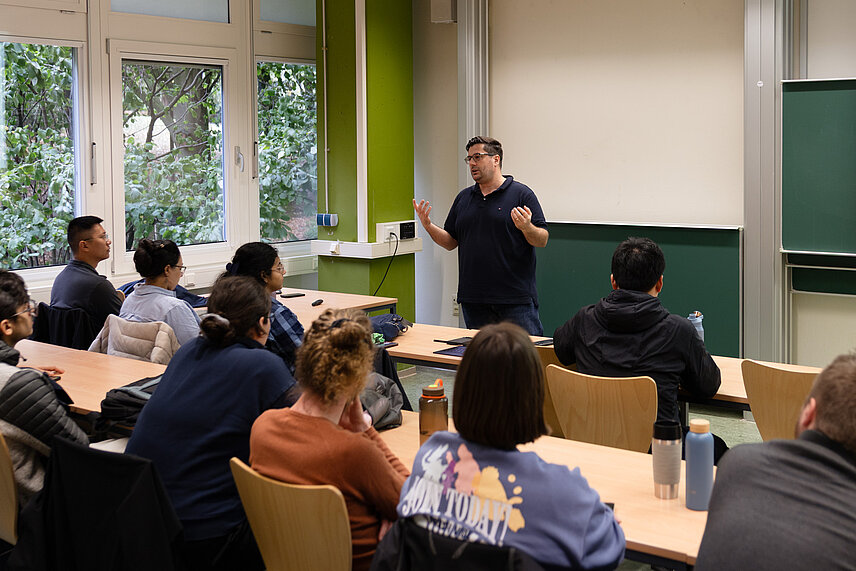 Photo: Burim Ramosaj © Patrick Wilking
How do you move from a PhD into industry? And which skills remain essential when AI can already write code, generate text, and suggest solutions?
These questions shaped a guest talk by Dr. Burim Ramosaj at TU Dortmund University on October 9. Now a Senior Data Scientist and Tech Lead at Google in Zurich, Burim Ramosaj returned to the university where he completed his PhD with Prof. Markus Pauly and later worked as a postdoctoral researcher. His original topic was concrete: the Google Student Researcher Program for PhD students. But the discussion soon moved beyond one company or one application process.
For the PhD researchers and postdocs in the room, Burim Ramosaj brought together two perspectives: that of someone who once faced similar career decisions in Dortmund, and that of someone who now works in an industrial research environment.
Discovery is key
Burim Ramosaj introduced Google’s different student pathways in engineering, research, and business before focusing on opportunities for PhD researchers. He explained how research experience can translate into an industrial setting and illustrated the range of problems researchers may encounter there.
His broader advice, however, was not to begin with a job title or a predefined solution. Start with the problem. Understand the context. Ask what can go wrong and how it might be improved. “Discovery is key,” he summarized during the talk.
The same idea shaped his advice on applications. For research-oriented roles, publications and scientific collaborations can matter. But Burim Ramosaj stressed that a CV should quickly make three things clear: what someone has done, what impact the work had, and what motivated it.
These points were presented in the context of Google, but much of the advice applies more broadly. Being able to explain a research problem clearly, understand its relevance, and communicate one’s own contribution is useful far beyond a single application process.
Who is a good fit for us?
The discussion became particularly lively when it turned to AI.
For Burim Ramosaj, using AI is not the opposite of independent thinking. The decisive question is whether researchers still understand the problem themselves. Can they recognize when an assumption does not hold? Can they identify edge cases? Can they explain why an AI-generated solution may be wrong?
In interviews, he said, the reasoning process can therefore be as important as the final answer. Candidates should explain how they approach a problem, ask clarifying questions, and be able to say when a proposed solution does not work. In research and professional practice alike, responsibility for the result remains with the person using the tool.
That message reaches well beyond an application to Google. As AI changes scientific work and professional roles, Burim Ramosaj argued for curiosity, critical thinking, and the confidence to tackle difficult problems rather than automatically looking for the easiest route. Toward the end of the discussion, he encouraged the researchers in the room to remain exploratory and to regard difficult problems as opportunities to learn rather than obstacles to avoid.
Career orientation through personal exchange
For RC Trust, the guest talk was also an opportunity to connect scientific training with career orientation. PhD researchers and postdocs need space not only to develop their research but also to explore where those skills might take them.
Inviting former researchers back to Dortmund creates such a space. It allows early-career researchers to ask practical questions about careers beyond academia and to hear directly how experience gained during a PhD can transfer into other professional environments.
Burim Ramosaj’s own path made that connection tangible: from doctoral research with Markus Pauly in Dortmund to research in industry – and, for one morning, back to where that path began.
Interested in learning more?
Google currently lists several research opportunities for students and PhD researchers. The Research Scientist PhD Intern, 2027 position in EMEA, for example, has an application deadline of October 23, 2026; applications are reviewed on a rolling basis. Google
Google Careers: Research Scientist PhD Intern, 2027
A broader Student Researcher, 2027 program is also currently advertised for several European locations, with an application deadline of December 13, 2026. Google
Google Careers: Student Researcher, 2027
Application details and deadlines reflect the Google Careers listings available at the time of publication and may change.
Category
- Talk
Author
Patrick Wilking