19.06.2026
The HUAM group helps bring the 10th ICRN Forum to Duisburg, connecting corruption research with technology, trust, and democratic responsibility.
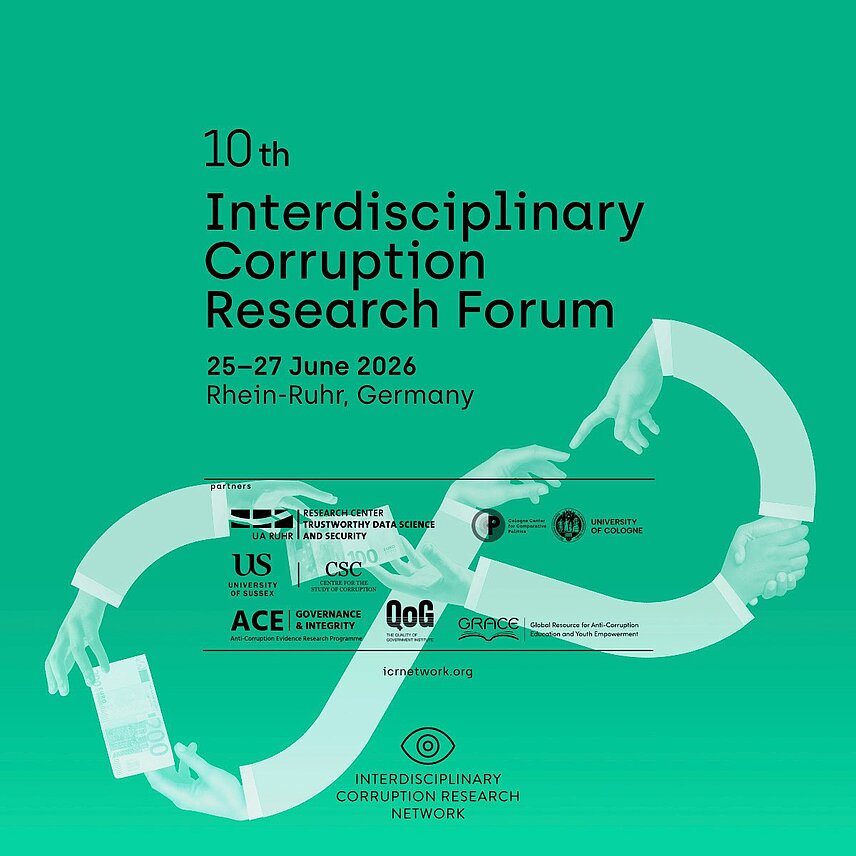 Graphic: 10th ICRN Forum
Corruption rarely starts with a suitcase full of cash. More often, it begins in less visible places: in decision-making routines, institutional blind spots, informal networks, misused data, or technologies that promise transparency but may also create new vulnerabilities.
This is why corruption research today can no longer be separated from questions of technology, trust, and democratic resilience. From 25 to 27 June 2026, these questions will take center stage in Duisburg, when the 10th Forum of the Interdisciplinary Corruption Research Network (ICRN) brings international early-career researchers to the Rhine-Ruhr region.
The forum will be jointly hosted by the Research Center Trustworthy Data Science and Security (RC Trust) at the University of Duisburg-Essen and the University of Cologne. It will take place at Collective.Ruhr in Duisburg.
The conference programme, including key information on keynote lectures and speakers, is available on the ICRN Forum website.
A forum for research that crosses boundaries
The Interdisciplinary Corruption Research Network brings together researchers from different disciplines who study corruption, anti-corruption, integrity, governance, and accountability. The 2026 forum focuses on society, innovation, technology, and (anti-)corruption – a thematic constellation that fits closely with the work of RC Trust.
The event is designed as a collaborative space for international early-career researchers from fields including political science, psychology, sociology, law, economics, history, and anthropology. Participants will present research, exchange ideas, develop new collaborations, and discuss how academic work can contribute to policy and practice.
For RC Trust, co-hosting the forum is not only a matter of academic visibility. It reflects a broader responsibility: to support research that helps societies understand and address threats to transparency, integrity, and democratic participation.
Why technology changes the corruption debate
Digital technologies are often presented as tools for accountability. They can help detect irregularities, make processes more transparent, and support oversight. But the same technologies may also produce new risks: opaque decision systems, data misuse, automated bias, or new forms of manipulation.
This tension is at the heart of the forum’s theme. Contributions on the nexus of technology and (anti-) corruption are particularly central to the event, which aims to bridge the gap between research and policymaking in the field.
That is also where the work of the Human Understanding of Algorithms and Machines (HUAM) group at RC Trust connects to the forum. HUAM investigates how people understand, trust, use, and respond to algorithmic systems. In the context of anti-corruption, this human perspective is essential. Technology alone does not create integrity. People, institutions, incentives, and social norms determine whether digital tools strengthen accountability or create new forms of risk.
Connecting anti-corruption research with RC Trust
The forum’s organization reflects the interdisciplinary character of the field itself. This year’s organizing team includes Prof. Nils Köbis and Dr. Carolina Gerli from the Human Understanding of Algorithms and Machines (HUAM) group at RC Trust, together with Dr. Anna K. Schwickerath from the University of Cologne. The forum is also supported by further members of Köbis’ chair, including Dr. Bianca Nowak, Fabian Albers, Sarah Langener, and Sebastian Meinken.
Prof. Nils Köbis, who leads the HUAM group, serves as host of this year’s forum in Duisburg. His work brings a behavioural and psychological lens to questions of corruption, trust, and technology. Together with members of his chair, he brings this perspective into the organization of the forum. It connects human decision-making with the design and use of algorithmic systems – a crucial perspective when societies ask how digital tools can support ethical behaviour rather than merely automate existing problems.
Dr. Carolina Gerli brings this perspective into the forum through her research on the complex relationship between artificial intelligence and corruption. Her work examines how AI can become both a tool for anti-corruption and a source of new risks, especially when questions of transparency, accountability, and governance are at stake.
With Dr. Anna K. Schwickerath from the University of Cologne, the organizing team also reflects the forum’s strong connection to comparative and interdisciplinary corruption research beyond RC Trust. This cooperation underlines the forum’s central idea: corruption cannot be understood from one institutional or disciplinary perspective alone.
Dr. Oksana Huss, also affiliated with RC Trust, is connected to the ICRN through her role as one of the network’s founding members. Her work contributes expertise in governance, resilience, anti-corruption, and international policy-oriented research. It connects academic analysis with institutional practice, particularly in contexts where democratic values, transparency, and accountability are under pressure.
Together, these perspectives show why corruption research belongs at RC Trust: because trustworthy data science and security are not only technical matters. They are deeply connected to how people act, how institutions function, and how societies protect democratic integrity.
Early-career research with societal relevance
The ICRN Forum places a strong emphasis on early-career researchers. It offers formats for advanced research, work in progress, and co-creation sessions designed to develop new ideas, collaborations, and research projects.
This matters because corruption is not a problem that can be solved from within a single discipline. It requires political analysis, legal knowledge, economic insight, psychological understanding, sociological awareness, and technological expertise. The forum creates a space where these perspectives can meet.
For students and early-career scholars, it also demonstrates how research can move beyond the page: into networks, public debate, policy questions, and international collaboration.
Research as responsibility
The forum’s solidarity statement with Ukraine underlines the values at stake: democratic principles, human rights, integrity, transparency, and accountability.
These are not abstract ideals. They shape whether societies can respond to crises, protect public trust, and maintain democratic institutions under pressure. For RC Trust, supporting this kind of exchange is part of a wider mission: to bring rigorous research into conversations that matter for society.
When international researchers gather in Duisburg in June, the topic will be corruption. But the larger question reaches further: how can societies build institutions, technologies, and cultures that deserve trust? That question sits at the core of RC Trust.
Category
- Network
- Event
Author
Patrick Wilking