28.05.2026
Carolina Gerli and Nils Köbis joined the Horizon RESPOND meeting in Lisbon to advance anti-corruption research.
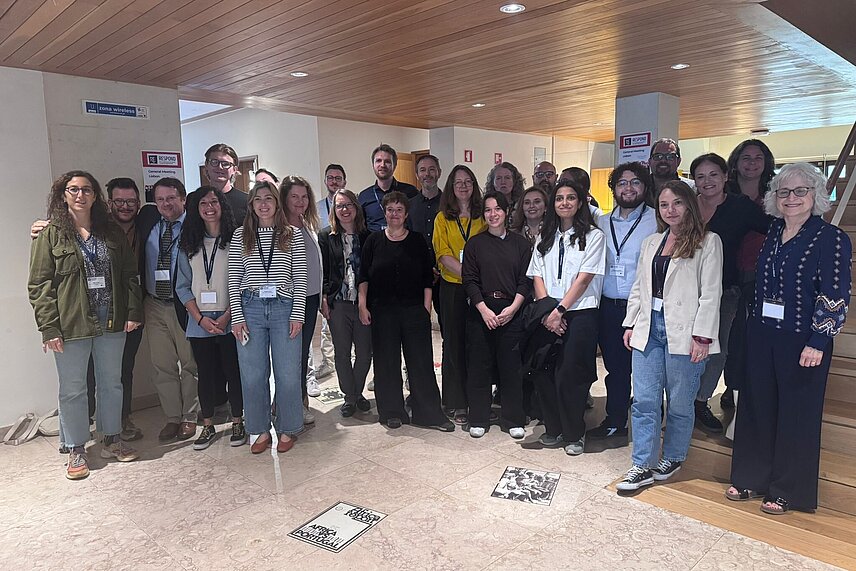 Photo: RESPOND's General Meeting in Lisbon on May 18-19.
Prof. Nils Köbis and Dr. Carolina Gerli from the Human Understanding of Algorithms and Machines (HUAM) lab at RC Trust took part in the General Meeting of the EU-funded Horizon project RESPOND (Grant Agreement No. 101132405) on May 18–19. Hosted by the Institute of Social Sciences at the University of Lisbon, the two-day event brought together consortium partners to review ongoing activities, exchange feedback, and coordinate the next phases of the project.
The RESPOND project seeks to better understand contemporary forms of political corruption, examine the dual role of digital technologies in enabling and combating it, assess its impact on democratic participation, and co-create new anti-corruption tools. Coordinated by the University of Bologna, the consortium includes academic institutions such as the University of Gothenburg, the University of Amsterdam, and King’s College London, alongside civil society organizations active in anti-corruption efforts, including Libera in Italy, the Anti-Corruption Research and Education Centre in Ukraine, and the Government Transparency Institute in Hungary.
The Lisbon meeting provided an important opportunity to strengthen interdisciplinary collaboration across the consortium and refine ongoing research activities and methodologies. Discussions centered on preliminary findings presented by several partners, brainstorming sessions on upcoming research activities, and the identification of practical synergies to support collaboration across the project over the coming year. The consortium also received highly positive feedback from the project’s Advisory Board, which includes representatives from international organizations such as the OECD and UNESCO, as well as senior scholars from leading European and international institutions and experts in public policy and anti-corruption governance.
In this context, the HUAM lab is currently contributing to a cross-national experimental survey exploring citizens’ perceptions of democracy, political participation against corruption, and emerging technologies designed to improve transparency, accountability, and integrity. Developed together with the University of Lisbon, the survey targets both the general public and anti-corruption activists across nine European countries: Bulgaria, France, Hungary, Italy, the Netherlands, Serbia, Sweden, Ukraine, and the United Kingdom.
As part of the survey, HUAM, in collaboration with the University of Amsterdam, has designed a choice-based conjoint experiment exploring public preferences towards AI-based anti-corruption technologies. The experiment examines key attributes of these systems, such as the type of user organization (governmental or non-governmental), the use of personal and sensitive data, and the degree of human supervision versus full autonomy.
Looking ahead, the HUAM lab will further expand its research activities within RESPOND, including a science-fiction-science experiment on AI use in anti-corruption and qualitative research on how AI and other emerging technologies may shape future corruption risks.
Category
- Network
- Event
Author
Carolina Gerli