12.05.2026
Leia Betting, a student of RC Trust PI Markus Pauly, receives award for outstanding master’s thesis in statistics.
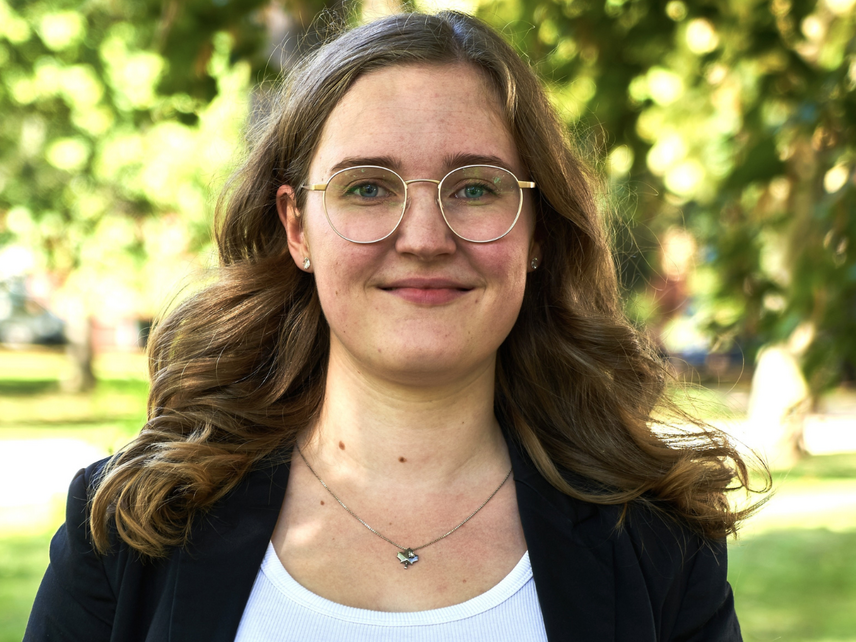 Photo: Leia Betting
Every day, millions of returnable bottles move through Germany’s recycling system. Behind this seemingly routine process lies a complex logistical challenge: companies must constantly anticipate when and where bottles will return, how large the material flows will be, and how recycling and sorting systems can adapt to changing demand.
Reliable forecasts are essential for making these processes more efficient, reducing waste, and improving the planning of industrial recycling systems. Yet, predicting return volumes is difficult. Seasonal effects, holidays, weather conditions, and changing consumer behavior can all influence how bottles move through the system.
This challenge became the focus of an award-winning master’s thesis by Leia Betting at the Department of Statistics at TU Dortmund University.
Award for outstanding master’s thesis
For her thesis Analysis of material flow composition in the returnable bottle sector through the development of forecasting models, Betting received the 2026 award for outstanding master’s theses from the Alumni Association of Dortmund Statisticians and Data Scientists. The prize honors exceptional final theses in statistics and related fields based on scientific innovation, practical relevance, originality, and methodological quality.
Betting completed the work under the supervision of Prof. Markus Pauly, Principal Investigator at the Research Center Trustworthy Data Science and Security (RC Trust), in collaboration with the recycling company REMONDIS.
The thesis was recognized for combining advanced statistical methodology with direct practical relevance for industrial recycling and sustainability processes.
Making recycling systems more predictable
In her work, Betting investigated how forecasting models can help better understand and predict material flows in the returnable bottle sector. The goal was to create a more reliable basis for planning sorting and recycling processes.
To achieve this, she compared different statistical and machine learning approaches for modeling return volumes over time. The work analyzed how well the models could capture fluctuations and recurring patterns in complex real-world data.
What makes the project particularly interesting is its practical perspective. Rather than studying abstract benchmark datasets, the research addressed a concrete industrial problem directly connected to sustainable resource management and circular economy processes.
More reliable forecasts can help companies better plan logistics, reduce unnecessary transport and storage capacities, and improve the efficiency of recycling systems overall. In large-scale returnable bottle networks, even small improvements in planning can have measurable environmental and economic effects.
At the same time, the work highlights an important broader lesson: sustainable infrastructures increasingly depend on trustworthy data-driven decision-making. Statistical models cannot eliminate uncertainty completely, but they can help make complex systems more understandable, predictable, and resilient.
From student project to research career
The thesis also reflects the close connection between research, teaching, and transfer at TU Dortmund University’s Department of Statistics.
Betting first approached Markus Pauly in search of a challenging and socially relevant master’s thesis topic. Through an ongoing cooperation with REMONDIS connected to the doctoral research of Jakob Becker, the project evolved into an industry-oriented research collaboration.
During her studies, Betting also worked as a student assistant at the Chair of Mathematical Statistics and Natural Sciences Applications. Since October 2025, she has continued her academic path as a research associate at the Department of Statistics under Prof. Roland Fried. There, she contributes to the Collaborative Research Center TRR 391, which develops statistical methods for complex and sustainable energy systems.
Statistics for real-world challenges
The project highlights how modern statistical research can contribute to addressing societal challenges beyond the laboratory or classroom. Whether in recycling systems, industrial logistics, or energy infrastructures, reliable data analysis and forecasting methods are becoming increasingly important for sustainable decision-making.
A further development of the research has resulted in a joint scientific publication by Leia Betting, Jakob Becker, Markus Pauly, and partners from REMONDIS. The paper, Forecasting Material Flow Composition in the German Returnable Beverage Container System, was published in the proceedings of the Conference on Production Systems and Logistics (CPSL) 2026.
For RC Trust PI Markus Pauly, the award also underlines the value of connecting statistical methodology with practical applications and interdisciplinary collaboration. At the same time, the work demonstrates how young researchers at TU Dortmund University are helping shape data-driven approaches to sustainability and trustworthy decision-making in real-world systems.