29.05.2026
Supervised by Markus Pauly, Paula Lorenz brought research from her bachelor's thesis to the international CEN conference.
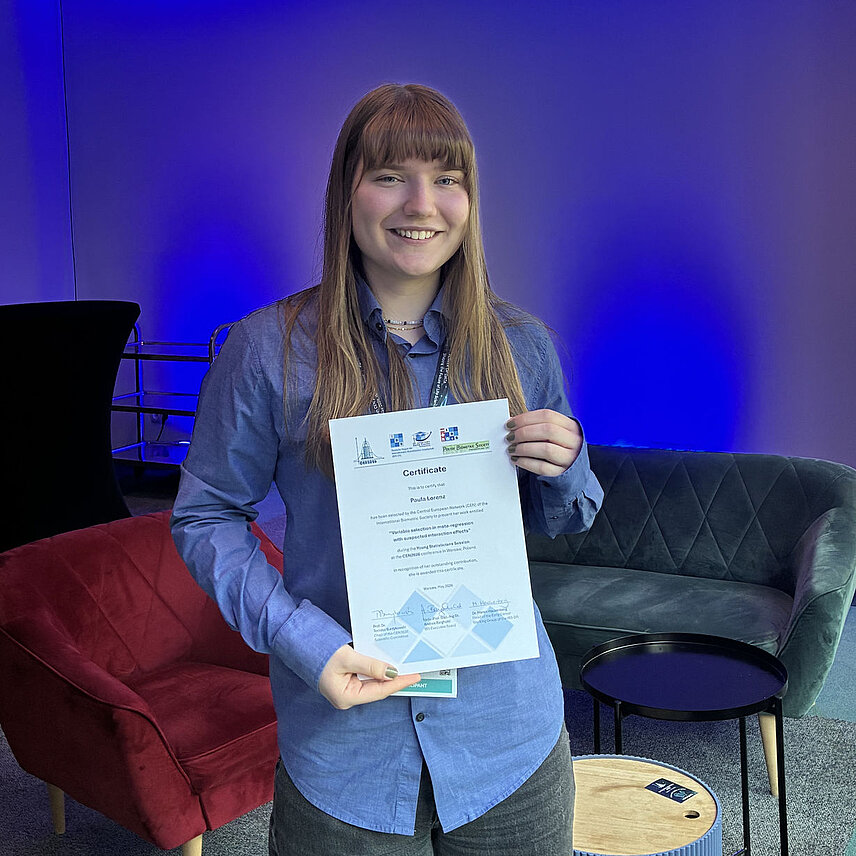 Photo: Paula Lorenz, © Jan-Bernd Igelmann
When a Bachelor’s thesis opens the door to international scientific exchange, it reflects both individual curiosity and a strong research environment. For Paula Lorenz, this journey began during her undergraduate studies at TU Dortmund University-and continues today within the research ecosystem shaped by Prof. Markus Pauly and the Research Center Trustworthy Data Science and Security (RC Trust).
In her Bachelor’s thesis, supervised by Markus Pauly, Paula Lorenz addressed a core challenge in applied statistics: how to select meaningful variables in meta-regression models when interaction effects are suspected. Her work, titled Variable Selection in Meta-Regression with Suspected Interaction Effects, focused on situations where traditional approaches struggle-especially when many potential variables meet only a small number of available studies.
Meta-analyses aim to synthesize evidence from multiple studies, for example in medical research. When results differ substantially, meta-regression can help explain this heterogeneity. In practice, however, decisions about which variables and interaction effects to include are often based on expert judgment alone. Paula Lorenz’s work took a different route by systematically comparing variable selection methods.
Alongside classical techniques such as significance testing and information criteria, she examined a tree-based approach known as meta-CART. Unlike linear regression models, tree-based methods split data step by step into subgroups, allowing them to capture more complex structures and interactions. This makes them particularly robust in scenarios common to meta-analyses, where the number of variables is high relative to the number of studies.
Although the thesis is primarily methodological, it is grounded in a concrete medical example: a meta-analysis on acute heart failure. Simulation studies and applied analyses showed that tree-based methods can outperform conventional approaches under realistic conditions-while still requiring careful interpretation to avoid spurious findings. Importantly, the methodology is transferable beyond medicine to many fields that rely on meta-analytic evidence.
Following her Bachelor’s degree in Data Science in autumn 2022, Paula Lorenz continued working on the topic as a student research assistant at Markus Pauly’s chair, closely connected to the RC Trust. In October 2025, she transitioned into the Master’s program in Statistics, further deepening her methodological focus. The research itself also progressed and is now being developed toward a full research paper.
In May, Paula Lorenz presented her work in a young researchers’ statistics session at CEN, bringing the core ideas of her Bachelor’s thesis into an international scientific setting.
For the RC Trust, this story illustrates how trustworthy data science grows: through strong statistical foundations, careful methodology, and close mentoring. Anchored by Markus Pauly’s work, Paula Lorenz’s path shows how early-career research can evolve into contributions with lasting scientific relevance.
Category
- Event
- Award
Author
Patrick Wilking