09.09.2026
Nico Föge defended his dissertation on interpretable Random Forests, missing data, and statistical uncertainty.
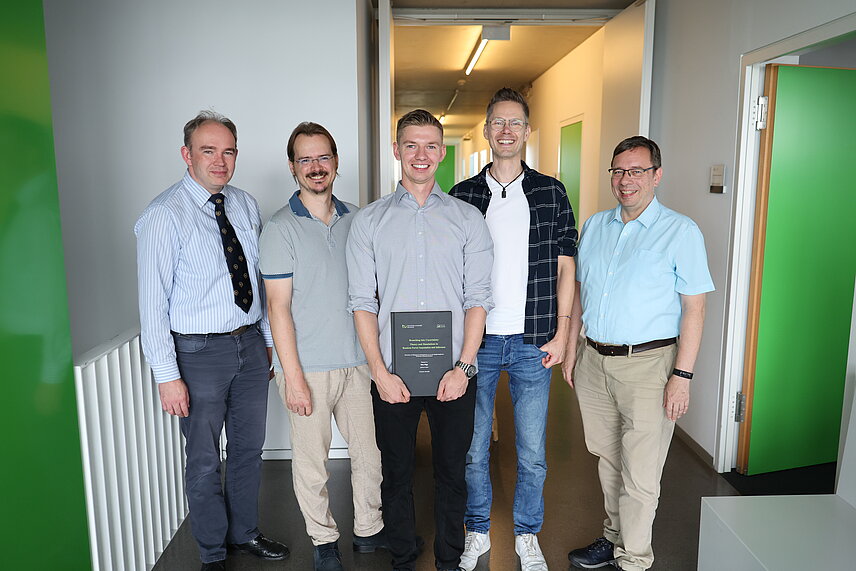 © Patrick Wilking
For Nico Föge, one uncertainty has now been resolved: he has successfully defended his doctoral dissertation at TU Dortmund University’s Department of Statistics.
The title, Branching into Uncertainty: Theory and Simulations in Random Forest Imputation and Inference, captures the subject well. Random Forests build predictions from many decision (or regression) trees. But Nico Föge’s research goes beyond asking whether a prediction is accurate. He investigates how reliably researchers can explain which variables contributed to it.
Imagine a model predicting an insurance risk. The prediction itself may be useful, but researchers may also want to know whether age, previous claims, income, or another variable was particularly influential. Methods known as feature importance try to provide such answers. For Nico Föge, this is closely connected to interpretable machine learning: understanding why a model reaches a result rather than treating it as a black box.
Putting uncertainty on firmer ground
Nico Föge’s cumulative dissertation brings together three studies. The first addresses a theoretical problem that had remained unresolved for several years. An existing approach allowed researchers to estimate uncertainty around feature importance in Random Forests, but lacked a full mathematical justification. Nico Föge and his co-authors proved a first central limit theorem of this kind. The result still relies on restrictive assumptions, something Nico Föge stresses himself, but provides a mathematical step toward more rigorous statistical inference for Random Forests.
The second study connects this question with another common problem: missing data. Real datasets are rarely complete. Values may therefore be statistically imputed, but replacing a missing value does not remove the uncertainty surrounding it. Nico Föge and Markus Pauly found that commonly used confidence intervals can perform poorly after such imputation and developed an alternative that also accounts for this additional uncertainty.
A third study turns to multilevel data – for example, students grouped within school classes. Here, Nico Föge and his co-authors examined whether tree-based machine-learning methods can help replace missing values while respecting such dependencies. Their simulations indicate potential for these methods, particularly in settings with larger proportions of missing data.
A doctoral path from Dortmund to Magdeburg and back
Part of Nico Föge’s doctoral path was shaped by Marc Ditzhaus, who passed away around two years ago. After completing his master’s thesis at TU Dortmund University under Markus Pauly’s supervision, Nico Föge began his doctoral research at Otto von Guericke University Magdeburg, where Marc Ditzhaus had become a junior professor after previously working in Markus Pauly’s group in Dortmund. Marc Ditzhaus was originally planned as the dissertation’s first supervisor and co-authored one of the three papers on which it is based.
Markus Pauly subsequently took over and supervised Nico Föge’s dissertation. He leads the Chair of Mathematical Statistics and Applications in Industry at TU Dortmund University’s Department of Statistics and is a Principal Investigator at RC Trust.
September is also Nico Föge’s final month at RC Trust. From October, Nico Föge will join Wavestone, where he plans to work on applied AI projects. Research connected to his time at RC Trust will also continue beyond his departure. Alongside the three studies included in his cumulative dissertation, Nico Föge contributed to further collaborative work, including the 2026 preprint When AI Joins the Team: Uncovering Team Dynamic Stability Using Fine-Grained Behavioral Coding.
For Nico Föge, the connection to trustworthy AI remains straightforward: the easier it is to understand which variables drive a model’s decisions – and how uncertain those explanations are – the better those decisions can be assessed.
Manuscripts developed during the doctoral period
Nico Föge, Lena Schmid, Marc Ditzhaus, Markus Pauly:
A Central Limit Theorem for the Permutation Importance Measure – arXiv preprint.
Read the paper on arXiv
Nico Föge, Markus Pauly:
Confidence Intervals for Random Forest Permutation Importance with Missing Data – arXiv preprint.
Read the paper on arXiv
Nico Föge, Jakob Schwerter, Ketevan Gurtskaia, Markus Pauly, Philipp Doebler:
Adapting Tree-Based Multiple Imputation Methods for Multilevel Data? A Simulation Study – Behavior Research Methods, 58, Article 166 (2026). Nico Föge and Jakob Schwerter share first authorship.
Read the open-access paper at Springer Nature
Category
- Staff
- Mathematical Statistics and Applications in Industry
Author
Patrick Wilking