01.06.2026
Co-initiated by Markus Pauly, a symposium in Göttingen explored new methods for meta-analysis.
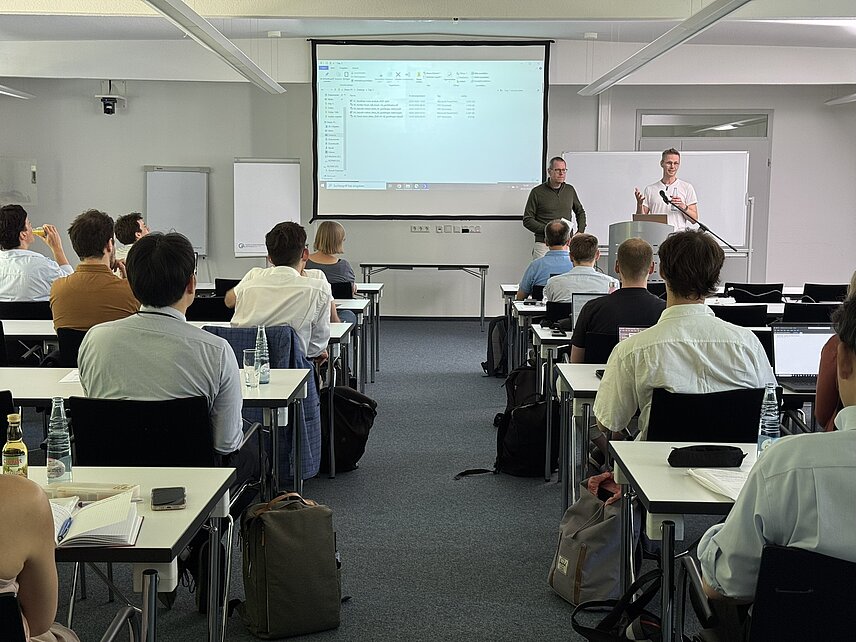
Medical decisions, treatment recommendations, and scientific guidelines often rely on combining results from several studies. This is the basic idea behind meta-analysis: instead of looking at one study alone, researchers bring together evidence from multiple sources to arrive at more reliable conclusions.
But what happens when only a few studies are available? What if sample sizes are small, results differ strongly, or the available data are difficult to compare? In these situations, the choice of the “right” statistical method determines how trustworthy the final conclusions can be.
This challenge was at the center of the symposium Recent Advances on Statistical Methods for Meta-Analyses, held on 28 and 29 May 2026 in Göttingen.
The symposium was initiated by Prof. Tim Friede and Dr. Christian Röver from the Department of Medical Statistics at the University Medical Center Göttingen, together with Prof. Markus Pauly from the Department of Statistics at TU Dortmund University.
The yearly format is part of the joint DFG-funded research project “Valid methods for meta-analyses with few studies and small sample sizes” by Tim Friede and Markus Pauly. The project addresses a central problem in evidence-based research: many important questions, especially in medicine and health sciences, must be answered under difficult conditions, where data are scarce, heterogeneous, or statistically fragile.
The aim is to develop methods that remain valid even when conventional assumptions are hard to meet. In practice, this means improving the tools researchers use to synthesize evidence, quantify uncertainty, and avoid overconfident conclusions.
International perspectives on meta-analysis
The programme brought together leading researchers from Germany, Europe, Japan, and the United States to discuss current challenges and new approaches in meta-analysis.
Invited speakers included Satoshi Hattori from the Department of Biomedical Statistics at Osaka University, Annika Hoyer from Biostatistics and Medical Biometry at the Medical School OWL, Bielefeld University, David Rindskopf from the City University of New York, Gerta Rücker from the Institute of Medical Biometry and Statistics at the University of Freiburg, and Wolfgang Viechtbauer from Maastricht University’s Faculty of Health, Medicine and Life Sciences and Faculty of Psychology and Neuroscience.
Their contributions reflected the breadth of the field: from methodological questions in heteroscedastic settings to practical challenges in medical and psycholgical research, where robust statistical conclusions can directly influence how evidence is interpreted.
Connecting methodology and trust
For the Research Center Trustworthy Data Science and Security (RC Trust), where Markus Pauly is a Principal Investigator, the topic connects directly to a broader research agenda: trustworthy conclusions require trustworthy methods.
Meta-analyses are often used precisely when decisions need a strong evidence base. If the underlying methods are not reliable, the conclusions may become unstable, misleading, or too confident. Developing valid statistical approaches for difficult evidence situations is therefore not only a methodological task, but also a contribution to trustworthy data-driven decision-making.
The Göttingen symposium showed how this work benefits from international exchange. By bringing together researchers from medical statistics, biostatistics, psychometrics, and methodological statistics, the event strengthened a scientific community working on one shared goal: making evidence more reliable.
Category
- Network
- Event
Author
Patrick Wilking