29.06.2026
Laurianne Sitbon visited the RC Trust Graduate School and Giulia Barbareschi’s chair to discuss inclusive co-design.
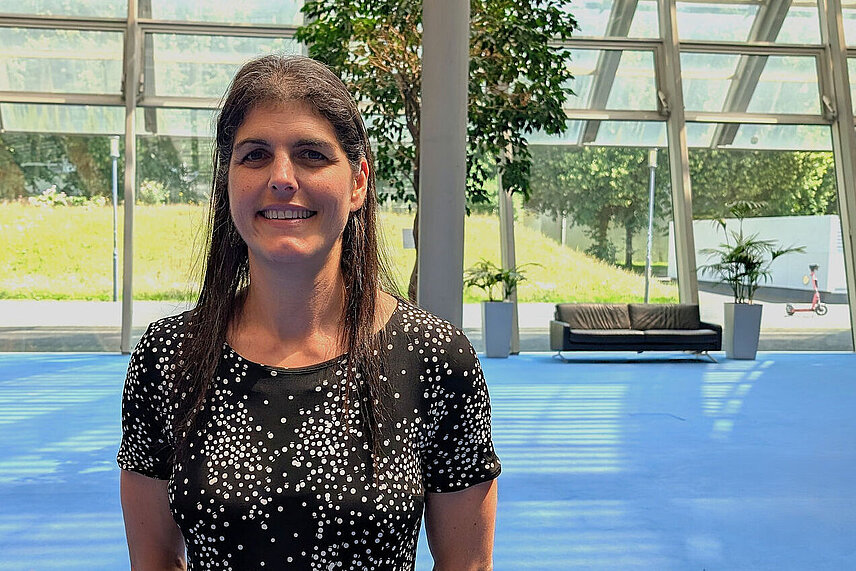 Photo: Laurianne Sitbon
A common assumption about technology and disability starts with what people cannot do. A blind person cannot see a screen. A person with intellectual disability may not use language, categories or abstract search fields in expected ways. From a distance, these may look like limitations.
Laurianne Sitbon takes a different direction: “Look at the abilities people have and build on them.” This sentence captures the principle behind Sitbon’s work on inclusive smart technologies. People who are blind may develop highly refined ways of navigating digital devices through sound and touch. People with intellectual disability may communicate through images, gestures, objects, body movements, attention or shared activity. The task is not to force everyone into the same interface, but to understand how people express themselves – and to design from there.
This shift in perspective shaped Sitbon’s talk at the Graduate School of the Research Center Trustworthy Data Science and Security (RC Trust) in Duisburg. During her stay, Associate Professor Laurianne Sitbon was a guest at the chair of Prof. Dr. Giulia Barbareschi, Inclusive Technology and Collective Engagement. Her talk, “Co-designing smart technologies for inclusion and self-expression: case studies with people with intellectual disability,” addressed one of the central challenges of inclusive technology: how smart systems can be developed not only for people, but with them.
Sitbon’s work begins with a productive tension between two ways of thinking. A classical engineering mindset often starts by defining a problem, building a solution, testing whether it works and measuring the outcome. This approach can be powerful. But it can also miss what matters in lived situations. Human-computer interaction asks different questions: What is actually happening when people encounter a technology? What do they bring to the interaction? Which forms of expression are visible, and which remain unnoticed? Which barriers are created by the system itself?
For Sitbon, co-design is therefore not a decorative add-on to technology development. It is a research method and a stance. It means bringing people into the process early, observing how they engage with prototypes, learning from unexpected uses, adapting methods and allowing research questions to change. Especially in work with people with intellectual disability, this requires moving beyond assumptions about deficits. It means creating situations in which people can show what they know, want, enjoy and imagine – sometimes without using words at all.
Her case studies made this approach tangible. Sitbon presented projects that explore how people with intellectual disability can use visuals, such as images or emojis, to communicate preferences, goals and stories. She discussed how recommendation systems might help people find images when search terms or categories are difficult to use. She also reflected on social robots, multimodal systems and vision-based technologies as spaces for interaction, learning and self-expression.
In these settings, technology is not simply assistive in a narrow sense. It can mediate conversation, support agency and create shared situations. A robot, for example, is not only a device responding to commands. It can become something people gather around, laugh about, move with, point to or use to connect with others. An image-selection system is not only a tool for finding pictures. It can become a way to tell a story, express a wish or start a conversation.
The problem Sitbon addresses is therefore not only technical. It is also methodological and ethical. If technologies are designed without the people they affect, they risk reproducing exclusion. If research methods only register what is easy to measure, they may overlook important competencies. And if smart systems are judged only by accuracy, efficiency or scalability, they may miss their social meaning.
This made the talk especially relevant for the RC Trust Graduate School. Trustworthy technology is not only a matter of robustness, security or performance. It also depends on participation, accessibility and the careful design of relationships between people and systems. For doctoral researchers, Sitbon’s work offered a concrete example of how research can change when methods are adapted to people rather than the other way around.
Associate Professor Laurianne Sitbon is a former Future Fellow of the Australian Research Council now Associate Professor in the School of Computer Science at Queensland University of Technology in Brisbane, Australia. Her research spans human-computer interaction, co-design, cognitive accessibility, natural language processing and information retrieval. She is also affiliated with the QUT Centre for Robotics, where she leads the human-robot interaction and inclusive robotics program.
Her visit reflects a key purpose of the RC Trust Graduate School: to expose doctoral researchers to international perspectives, interdisciplinary methods and questions that reach beyond technical development alone. In this case, the lesson was clear. Smart technologies become more trustworthy when the people most affected by them are not treated as an afterthought, but as co-creators of the future they will inhabit.
Category
- Talk
- Network
Author
Patrick Wilking