20.11.2026
Visiting Giulia Barbareschi: Jack Brophy explores cultural storytelling through VR and AI.
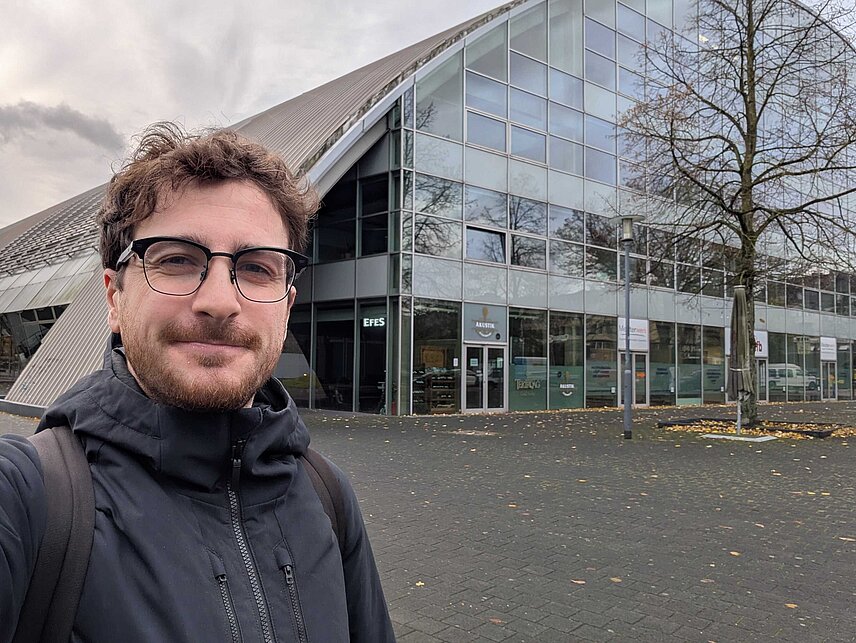 Photo: Jack Brophy in front of the Tectrum on the Duisburg campus
In the past, anyone who wanted to experience other cultures firsthand had to travel abroad. With the use of AI, these cross-cultural experiences are now also possible in virtual spaces. In virtual environments, people can, for example, share their culture and personal experiences with one another. Jack Brophy, a PhD candidate at Keio University’s Graduate School of Media Design, explores how people, particularly those with migrant backgrounds, can use AI to create such spaces and share their stories.
Participants use a custom browser-based platform to create a 360-degree environment assisted by AI. The AI builds the scenery while the user adds photographs, drawings, or text to personalize the space. In his project, one participant in Germany pairs up with another in Japan to explore the spaces they have created in VR. As avatars, they discuss their respective stories and experiences within these environments. Brophy examines both how the spaces are created and how the other person interprets the representations.
AI in the room
In the past, producing such virtual spaces was only possible with extensive programming knowledge. Generative AI has lowered this barrier. However, using AI also brings unintended side effects. The generated representations may, among other things, contain cultural biases or misrepresent people and their cultures. Brophy therefore works with diverse user groups to examine how these tools can “not only enable, but also restrict” their ability to tell stories.
There and together again
From October 9 to November 21, 2026, Brophy is working as a visiting researcher with Prof. Giulia Barbareschi and her Inclusive Technology and Collective Engagement group at RC Trust at the University of Duisburg-Essen. The two know each other from Barbareschi’s time at Keio University. Her experience in involving marginalized communities in research was a key reason for his research stay in Duisburg.
Category
- Network
- Inclusive Technology and Collective Engagement
Author
Patrick Wilking