06.08.2026
Erasmus intern Enes Ün joins Markus Pauly’s group to explore MANOVA, simulations, and academic research in Dortmund.
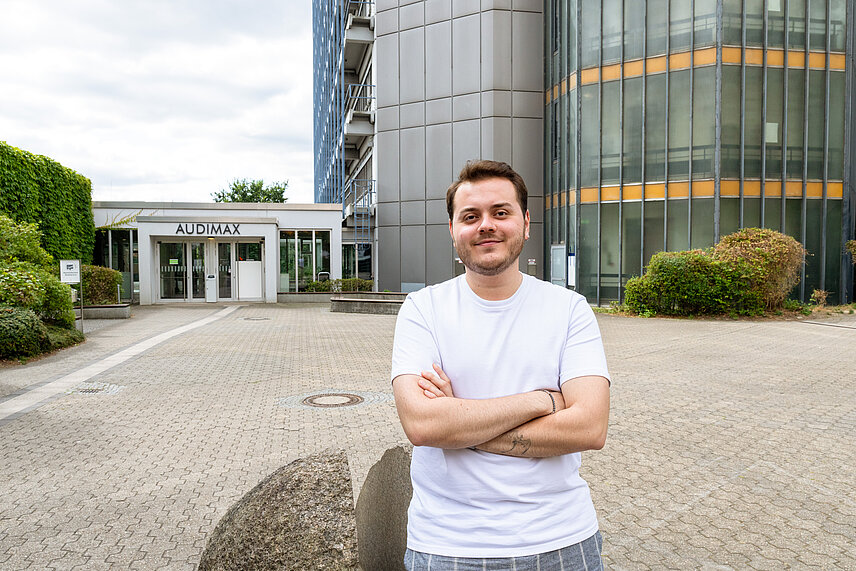 (c) Patrick Wilking
A statistical method may look convincing in theory. The harder question is what happens when the data become small, uneven, or simply refuse to behave as expected.
One way to find out is through simulation. Researchers create artificial datasets under different conditions, apply a statistical method repeatedly, and observe when it produces reliable results – and when it reaches its limits.
This is part of the work Enes Ün is getting to know during his Erasmus+ internship at TU Dortmund University.
From Istanbul to Dortmund
Enes studies Computer Science and Engineering at Sabancı University in Istanbul. From 15 June to 30 September 2026, he is spending three and a half months in the group of Prof. Markus Pauly at TU Dortmund University’s Department of Statistics.
Pauly leads the Chair of Mathematical Statistics and Applications in Industry and is a Principal Investigator at the Research Center Trustworthy Data Science and Security (RC Trust).
Enes became interested in the group while looking for an internship in Germany. He hopes to pursue a Master’s degree in the country and names TU Dortmund University as one of the places where he would particularly like to continue his studies. His programming experience and previous work with data analysis and visualisation provided a useful foundation for the internship, whose official focus is functional data analysis.
Learning through simulation
During his stay, Enes is working with Marléne Baumeister and supporting research connected to a DFG-funded project. Through their discussions, the focus of his work developed towards MANOVA and simulation studies.
MANOVA – multivariate analysis of variance – is used when several related outcomes are examined at the same time. In medical research, for example, these might include blood pressure, heart rate, and other measurements collected from the same patients.
Simulation studies help researchers test how statistical procedures perform under different conditions. Using the programming language R, Enes generates datasets with known properties, analyses them repeatedly, and compares the results. As simulating is very computationally intensive, he uses the supercomputer from TU Dortmund University LiDO3 for the calculations.
For Enes, this process captures what he finds particularly appealing about data science: constructing scenarios, testing suitable methods, and identifying patterns that become visible only across many repetitions.
A first look at academic research
Beyond the technical work, Enes wanted to experience how academic research is organised in practice. Working with experienced researchers, adapting a project through open discussion, and gaining more independence were central goals for his stay.
More than a month into the internship, he says he has been particularly impressed by the open communication and intellectual freedom within the group.
When he returns to Sabancı University, Enes hopes to take back practical experience in multivariate statistics and R, as well as a clearer understanding of research as a possible next step in his academic path.
Category
- Staff
Author
Patrick Wilking