14.07.2026
Ruhr Fellow David Broczkowski studies transformer verification in Daniel Neider’s group at RC Trust.
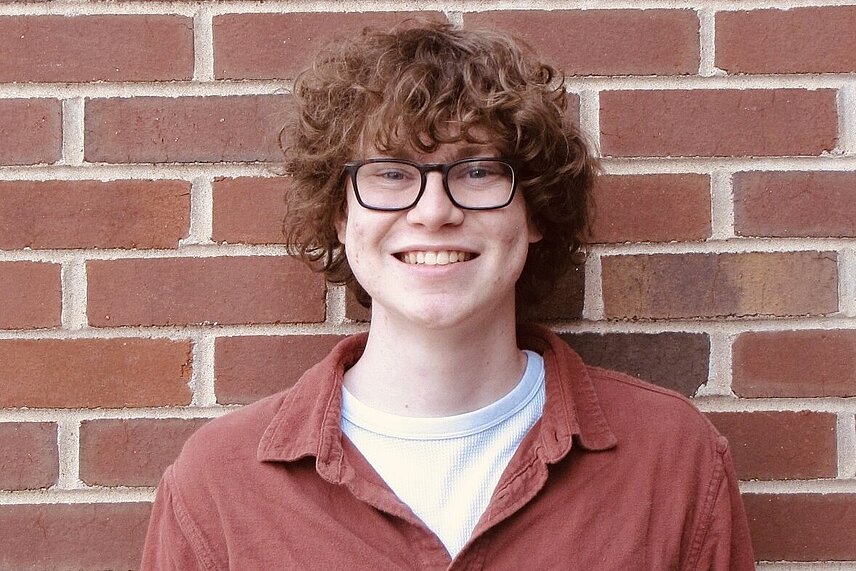 Photo: David Broczkowski
What happens when an AI system encounters an input that differs only slightly from what it expects? For a chatbot, the result might be an inaccurate answer. In a car, aircraft, or another safety-relevant setting, unpredictable behaviour could have much more serious consequences.
This question is at the center of David Broczkowski’s research internship at the Research Center Trustworthy Data Science and Security (RC Trust). David is a third-year student at Lafayette College in the United States, where he is pursuing a dual degree in Computer Science and German. From June 8 to July 24, he is working in the Verification and Formal Guarantees of Machine Learning group headed by Prof. Daniel Neider.
David studies methods for verifying transformers and a related class of models known as Transformer Programs. Transformers form the basis of many widely used AI systems. Verification seeks to determine whether these models behave reliably when their inputs are changed or deliberately perturbed.
His particular focus is on runtime: how efficiently different transformer structures can be analysed. His daily work includes refactoring code, running experiments on smaller tasks, looking for patterns in the results, and discussing the next steps with Daniel Neider, Patrick Nossol, Simon Lutz, and other members of the verification group.
The topic brought David to RC Trust because he is interested in ways of improving AI that go beyond adding more parameters or training data. Verification and alternative model architectures may help make systems more predictable while also reducing unnecessary resource use.
The internship is also giving him his first close look at everyday academic research. David wants to learn how researchers develop ideas together, work with larger codebases, and respond when a project does not immediately produce clear results. A workshop on designing research posters, for example, showed him that presenting research is not only about finished findings, but also about explaining the path taken so far.
Lunches with the team, weekly meetings, and occasional game nights have helped him settle into the group. He is also using the stay to practise his German and to learn more about living and working outside the United States.
Moving to a new country and beginning an unfamiliar project pushed him beyond his comfort zone. But that, David says, is part of the value of the experience: “The lessons I learn go beyond the computer.”
About the Ruhr Fellowship Program
The Ruhr Fellowship Program brings undergraduate students from the United States to the Ruhr region. Participants complete an intercultural and language immersion program, followed by either an internship with a regional company or a research internship at one of the University Alliance Ruhr universities.
Category
- Network
- Staff
Author
Patrick Wilking