09.11.2026
Greta Ontrup and Magdalena Wischnewski co-authored a BritCHI paper challenging how we define AI teammates.
AI assistants can analyze information, suggest solutions, and help coordinate work. Some communicate in ways that resemble human interaction. But when does a useful tool become something closer to a team member? And does it matter how we describe it?
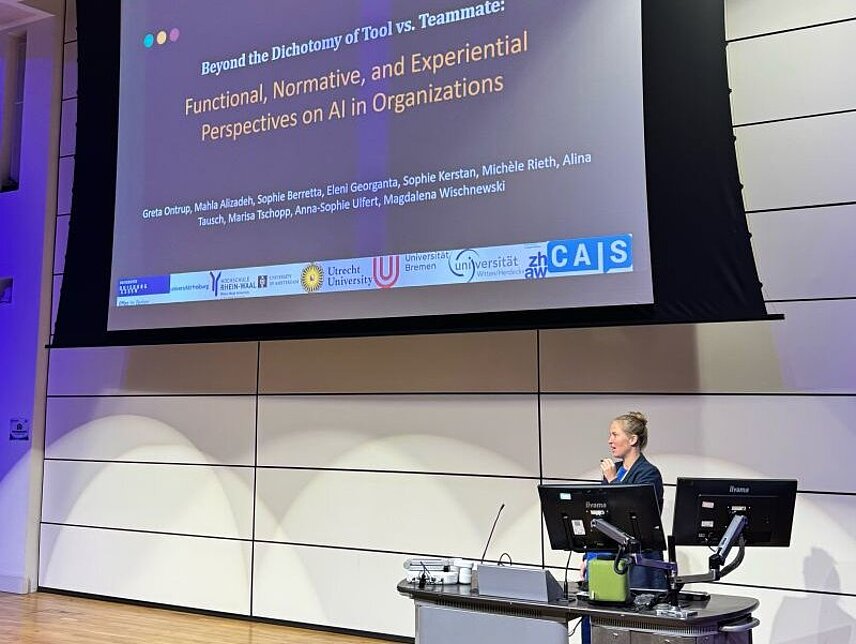
These questions are explored in Beyond the Dichotomy of Tool vs. Teammate: Functional, Normative, and Experiential Perspectives on AI in Organizations, a paper by ten researchers presented at BritCHI 2026, held November 1–3 in London.
An international research team, including Greta Ontrup and Magdalena Wischnewski from RC Trust, argue that the familiar distinction between AI as a tool and AI as a teammate overlooks an important point: What a system can do, how people experience it, and what responsibilities it should have are three different questions.
Three Ways of Looking at AI
To clarify the debate, the researchers distinguish three perspectives.
The functional perspective examines what an AI system actually does: the tasks it performs, the decisions it supports, and how independently it operates.
The normative perspective considers what role it should be allowed to play. Who remains accountable for decisions? How much control should humans retain? And where should the boundaries be drawn?
The experiential perspective focuses on how people perceive and interact with AI. Do they trust its recommendations? Do they treat it as a colleague? And how does this affect their behavior?
These perspectives do not necessarily lead to the same conclusion. An AI assistant might perform tasks traditionally assigned to human colleagues and even be perceived as part of a team. Yet this does not mean it can assume the same ethical or legal responsibilities.
This distinction has practical implications. A system that communicates naturally and offers suggestions on its own may encourage people to treat it as a social partner, regardless of how an organization officially defines its role. Its technical capabilities, the expectations it creates, and the responsibilities assigned to it may not always align.
Rather than presenting new experimental findings, the paper offers a conceptual approach to examining these differences and informing future research on human–AI collaboration.
From a CAIS Workshop to an International Research Network
The paper grew out of an international research collaboration initiated through You, I, and AI: Future Scenarios of Human-AI Teaming, a workshop funded by the Center for Advanced Internet Studies (CAIS). It was organized by Greta Ontrup, Magdalena Wischnewski, and Dr. Alina Tausch from Witten/Herdecke University.
The workshop also gave rise to the HAITeC Network (Human, AI, Teams, and Emerging Collaboration), which brings together researchers studying the psychological and social dimensions of human–AI teamwork.
At RC Trust, Greta Ontrup leads the Young Investigator Group Psychological Aspects of Human-Algorithm-Interaction, while Magdalena Wischnewski heads Human Factors in AI Systems. Their involvement in the paper connects their research on human interaction with AI to a broader international discussion about the changing nature of teamwork.
Category
- Network
- Psychological Aspects of Human-Algorithm-Interaction
- Human Factors in AI Systems
Author
Patrick Wilking