08.07.2026
At ACL 2026, Ivan Habernal and Bilal Zafar brought RC Trust research to pressing questions in trustworthy NLP.
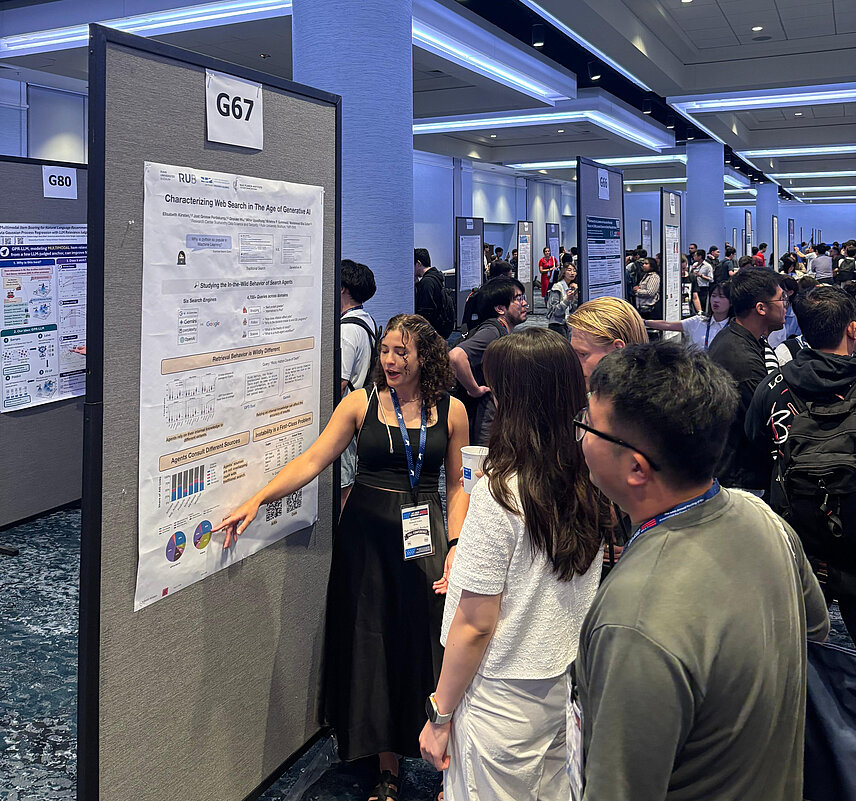 Photo: Elisabeth Kirsten
When language technologies enter everyday life, they do not arrive as neutral tools. They rank information, rewrite queries, classify organizations, remove sensitive data, and sometimes decide what users get to see first. At the 64th Annual Meeting of the Association for Computational Linguistics (ACL 2026), researchers from the Research Center Trustworthy Data Science and Security (RC Trust) addressed precisely these fault lines: privacy, robustness, evaluation, and the changing relationship between people and language-based AI systems.
RC Trust was represented at ACL 2026 with three research contributions and one workshop. The contributions came from Prof. Ivan Habernal’s Trustworthy Human Language Technologies group at Ruhr University Bochum and from Prof. Muhammad Bilal Zafar’s Artificial Intelligence and Society group, with PhD researcher Elisabeth Kirsten.
In Conundrum of Trustworthy Research on Attacking Personally Identifiable Information Removal Techniques, Sebastian Ochs and Ivan Habernal examine a difficult paradox in privacy research. Removing personally identifiable information from text is essential for data protection and responsible data sharing. At the same time, research on attacking such techniques often depends on evaluation settings that may not reflect real-world privacy risks. The paper asks how the research community can study vulnerabilities in a transparent and reproducible way when the most meaningful data is, for good reasons, private.
Habernal was also involved in MONETA: Multimodal Industry Classification through Geographic Information with Multi Agent Systems, together with Arda Yüksel from TU Darmstadt, and Gabriel Thiem, Susanne Walter, Patrick Felka, and Gabriela Alves Werb from the German Federal Bank. The paper looks at industry classification, a task that underpins public and corporate databases but is often costly to perform manually. MONETA combines textual sources such as websites, Wikipedia, and Wikidata with geographic information including OpenStreetMap and satellite imagery. The work shows how multimodal language models and multi-agent systems can support classification without retraining models for each new taxonomy.
A third contribution turned to one of the most visible shifts in digital information access. In Characterizing Web Search in The Age of Generative AI, Elisabeth Kirsten, Jost Große Perdekamp, Qinyuan Wu, Mihir Upadhyay, Krishna P. Gummadi, and Muhammad Bilal Zafar compare traditional web search with generative search systems. Instead of presenting ranked lists of links, generative search engines retrieve, synthesize, and summarize information into a single response. The study shows that this changes not only the interface, but also the underlying dynamics of source diversity, stability, and evaluation.
Beyond the paper program, Ivan Habernal co-organized PrivateNLP: Seventh Workshop on Privacy in Natural Language Processing with Sepideh Ghanavati, Sara Haghighi, Krithika Ramesh, Timour Igamberdiev, and Shomir Wilson. The workshop brought together researchers working on privacy-preserving natural language processing, including differential privacy, federated learning, machine unlearning, memorization attacks, and the verification of privacy-preserving NLP systems.
ACL is one of the central international venues for research in computational linguistics and natural language processing. ACL 2026 took place from 2 to 7 July 2026 in San Diego and brought together researchers working on the scientific, technical, and societal questions raised by language technologies.
Category
- Publication
- Network
- Event
Author
Patrick Wilking