26.03.2026
Rachel Griffin and Mateus Correia de Carvalho explore participation and justice in EU platform regulation.
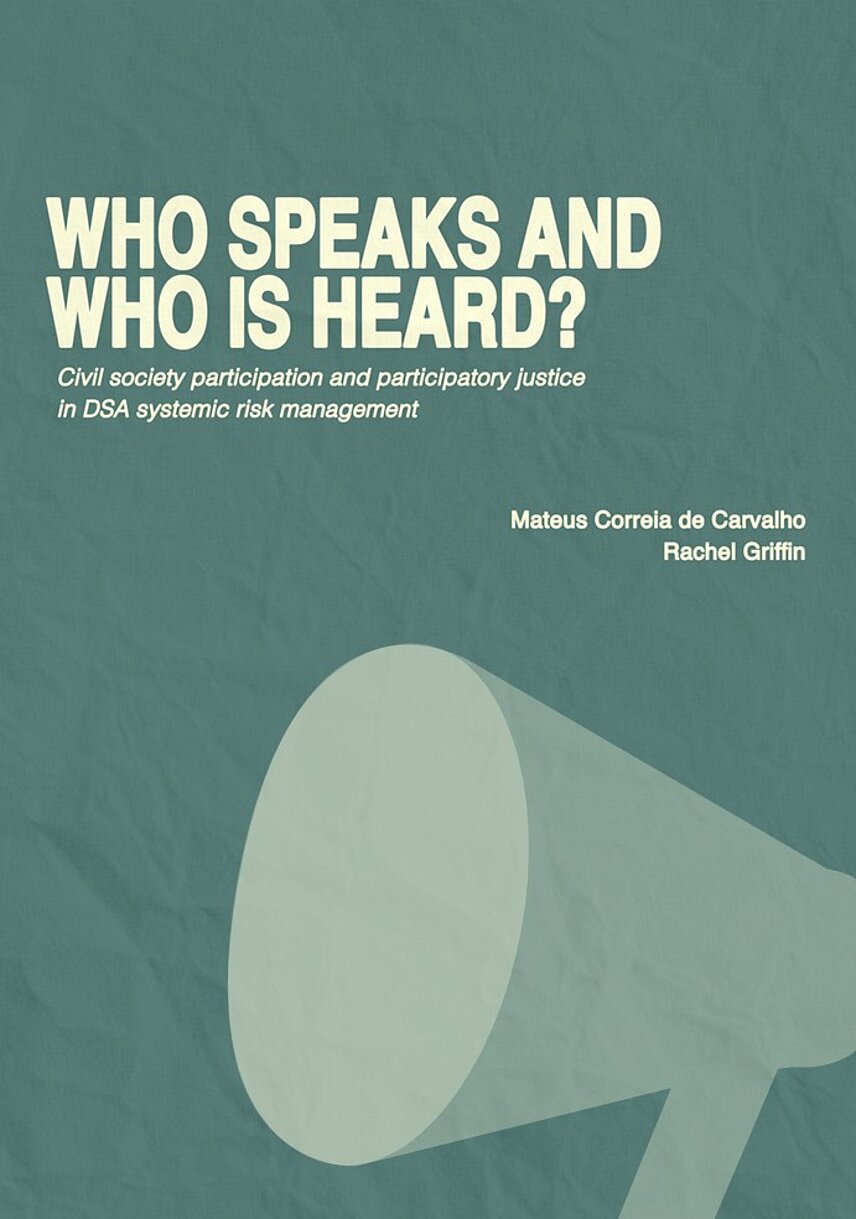
Who gets to shape the rules of the digital world–and whose voices are left unheard?
This question lies at the heart of a recent publication by Dr. Rachel Griffin, postdoctoral researcher at RC Trust in the Compliant and Accountable Systems group led by Prof. Dr. Jat Singh, co-authored with Mateus Correia de Carvalho (European University Institute). Their report, Who speaks and who is heard? Civil society participation and participatory justice in DSA systemic risk management, examines how different actors influence the governance of large online platforms in Europe.
Rather than focusing on technology alone, the work addresses a central challenge of digital governance: how societal risks – such as online violence, algorithmic bias, or threats to democratic discourse–are defined, prioritized, and managed under the EU’s Digital Services Act (DSA). At the core is the idea that these processes are not purely technical or legal, but deeply shaped by power, access, and representation.
The study brings together empirical and conceptual perspectives. Based on qualitative research, including focus groups and interviews with a wide range of civil society actors, it shows how participation in platform governance unfolds in practice. Civil society organizations, researchers, journalists, and advocacy groups contribute knowledge, challenge platform practices, and attempt to influence regulatory decisions–but not all voices carry the same weight.
A key contribution of the report is its analysis of participatory justice. It highlights three types of inequalities that shape who is heard: unequal access to resources, unequal access to decision-making spaces, and unequal recognition of different perspectives. These dynamics mean that some actors–often those closest to affected communities–face structural barriers when trying to influence how risks are understood and addressed.
Beyond diagnosing these challenges, the work also sheds light on the broader ecosystem of platform governance. It explores how knowledge is produced and used in regulatory processes, how advocacy strategies–from research to litigation–shape outcomes, and how political and institutional contexts influence what counts as a “risk” in the first place.
For society, these questions are highly consequential. The way risks are defined under the DSA affects not only how platforms moderate content or design their systems, but also how fundamental rights, public discourse, and social cohesion are protected in digital environments. Ensuring that a diverse range of perspectives is included in these processes is therefore essential for building more just and accountable digital infrastructures.
Rachel Griffin’s work at RC Trust contributes to a growing effort to ground digital regulation in both technical realities and societal concerns. By focusing on participation, power, and justice, her research helps to better understand not only how platform governance works–but how it can be improved to serve a broader public.
The publication is available as Open Access.
Category
- Publication
Author
Patrick Wilking