Real-world data rarely follows the assumptions that statistical models would ideally rely on. It may be noisy, unevenly distributed, or shaped by hidden mechanisms. For researchers who want to distinguish cause and effect, this is not merely a technical detail. It can influence whether a method identifies the correct causal direction.
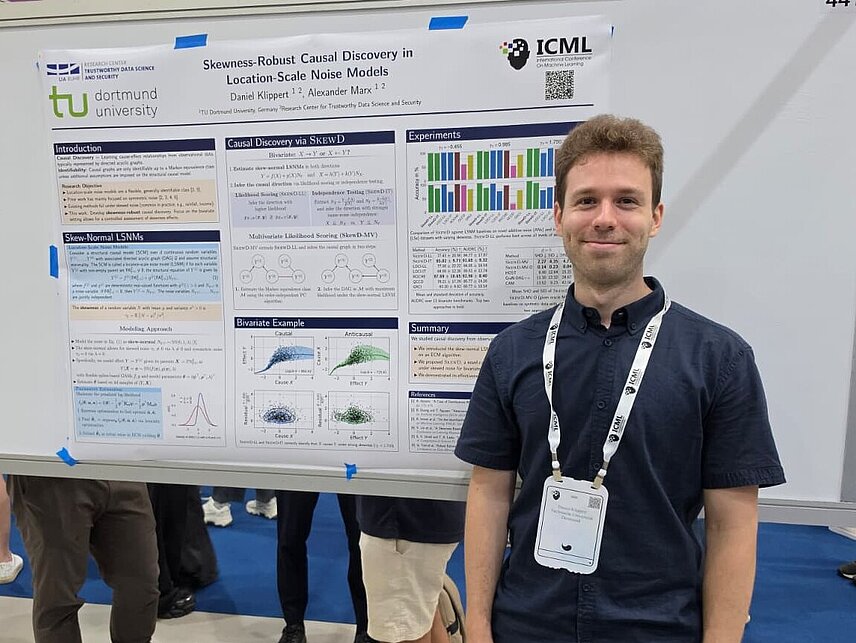
Daniel Klippert from the Causality group of Prof. Alexander Marx at the Research Center Trustworthy Data Science and Security (RC Trust) presented the poster Skewness-Robust Causal Discovery in Location-Scale Noise Models at the 43rd International Conference on Machine Learning (ICML 2026) in Seoul, South Korea. The paper is co-authored by Alexander Marx.
ICML is one of the major international conferences in machine learning. For the Causality group at TU Dortmund University’s Department of Statistics, the contribution brings a central research question to an international audience: how can researchers infer not only that two variables are related, but which one is the cause and which one is the effect?
This question lies at the heart of causal discovery. To distinguish cause and effect, researchers need to impose additional assumptions on how the data was generated, since both causal directions may otherwise appear equally plausible. One such assumption is given by the class of location-scale noise models, which are flexible enough to capture a wide range of real-world relationships. In simple terms, this modeling assumption describes how the effect depends on the cause and on noise – a random variation that also influences the effect.
A common simplifying assumption is that this noise is symmetrically distributed. In real-world data, however, this assumption can be violated. Distributions can be skewed, for example when rare but large deviations occur more often in one direction than in the other. Daniel Klippert and Alexander Marx show that methods relying on symmetric noise can lose accuracy under such conditions.
Their proposed method, SkewD, addresses this limitation. It extends location-scale noise models to the skew-normal setting, allowing for both symmetric and skewed noise. To perform likelihood-based cause-effect inference, the method estimates model parameters using an expectation maximization algorithm. The paper also includes an independence-test version for the bivariate case and extends the approach to multivariate data.
The relevance reaches beyond a single statistical detail. AI systems are increasingly used to support decisions in complex environments, where data is rarely ideal. If causal methods are to be useful outside controlled examples, they need to remain reliable under more realistic conditions. Work such as SkewD contributes to this goal by examining where existing assumptions become fragile – and how methods can be adapted accordingly.
For RC Trust, the ICML contribution reflects a broader research interest: developing data science and machine learning methods that remain robust when they meet the irregularities of the real world.