Some questions in artificial intelligence cannot be answered by observation alone. Intelligent systems often need to interact with their environment, test possible actions, observe their consequences, and learn from what changes. This is where reinforcement learning and causality begin to meet.
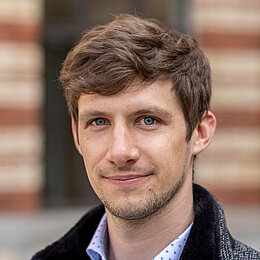
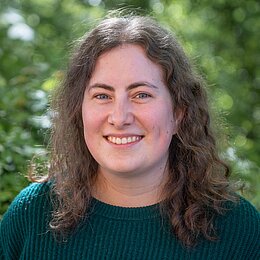
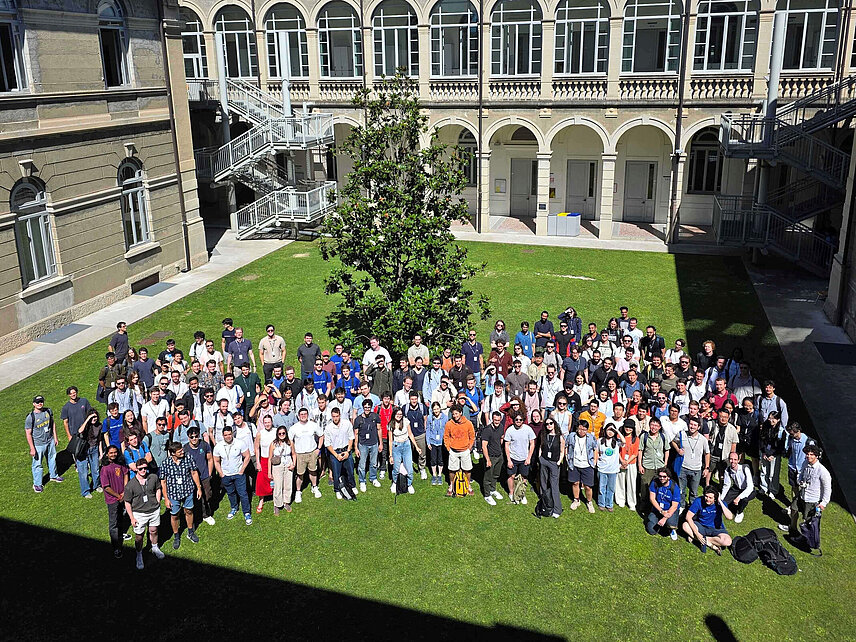
Gabin Agbalé, a second-year PhD student in the Causality group of Prof. Alexander Marx at the Research Center Trustworthy Data Science and Security (RC Trust), attended the Reinforcement Learning Summer School in Milan from June 3 to 12, 2026. The program brought together Master’s students, PhD students, postdocs, and researchers interested in the foundations and latest developments of reinforcement learning.
For Gabin Agbalé, the connection to his own doctoral research was direct. Alexander Marx’s group works on causality broadly, including causal inference, causal discovery, and causal fairness. Gabin focuses on a particularly challenging setting: cases in which causal variables are not directly observable. Images are one example. Before researchers can reason about causal mechanisms in such data, they first need to recover meaningful representations of the underlying variables. This field is known as causal representation learning.
Reinforcement learning offers a natural bridge. While many AI systems learn from static data, reinforcement learning studies agents that interact with their environment. They take actions, observe outcomes, and adjust their behavior. “Causality and reinforcement learning are intrinsically very connected,” Gabin explains. Intelligent agents can grasp causal mechanisms not only by observing the world, but by intervening in it. Yet the relationship between the two fields remains underexplored.
The summer school therefore came at the right moment. Gabin is part of an Interdisciplinary Working Group with Alexander Kichutkin and Mislav Stojanović that investigates this connection. In Milan, he was able to present early theoretical and experimental results during a poster session and receive feedback from other participants. The setting was smaller and more focused than a large conference, which made conversations easier and more productive.
One lecture that stood out to him was Michal Valko’s talk on world models. These models learn an internal representation of an environment that an agent can use for planning: starting from a current observation, the model predicts how the world might change after a certain action. The talk moved from the broader intuition behind the idea to its contested history within machine learning and then into technical aspects of training such models, including links to self-supervised learning.
The poster session became one of the most valuable moments of the program. Since only a few participants were already familiar with causality and representation learning, Gabin first had to introduce the field and his own work. That effort opened the door to more substantial discussions and new perspectives. It also showed how important scientific exchange can be when research fields begin to overlap.
Beyond the lectures, the summer school offered what large conferences sometimes cannot: time to learn, time to ask basic questions, and time to build connections. For Gabin, who had no prior formal training in reinforcement learning, the ten-day program provided a path from fundamental concepts to more advanced and recent research, including practical sessions.
The experience will feed directly into his work at RC Trust. Some of the concepts are already relevant for the Interdisciplinary Working Group. More broadly, the contacts made in Milan may become the starting point for future collaborations.
For early-career researchers, such formats are more than training opportunities. They create spaces in which ideas travel, fields meet, and young scientists test how their work resonates beyond their immediate research environment. In Gabin’s case, Milan offered exactly that: new tools for his PhD, feedback for ongoing work, and a clearer view of how causality and reinforcement learning might learn from each other.