01.06.2026
Doctoral researcher Maria Thurow brings biostatistician Thomas Alexander Gerds to TU Dortmund for a lecture on causal inference.
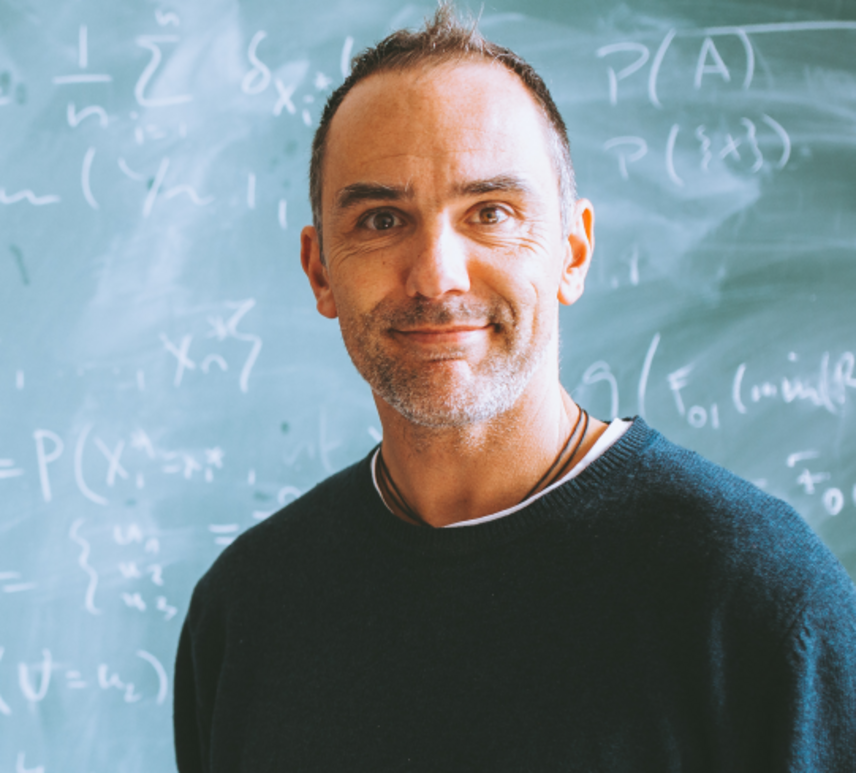 Photo: Thomas Alexander Gerds
Medical data rarely tells a simple story. Patients begin or stop treatments, health conditions change over time, and important information is often collected under real-world conditions rather than in controlled experiments. Yet researchers and physicians still need to answer difficult questions: Which treatments actually help? Which risks matter most? And how can reliable conclusions be drawn from constantly evolving data?
These questions are at the center of modern biostatistics – and they will also shape an upcoming guest lecture at TU Dortmund University by Prof. Thomas Alexander Gerds from the University of Copenhagen.
The lecture, titled Causal Inference in Continuous Time, will take place on June 10, 2026, at 10:00 a.m. at the International Meeting Center (IBZ) of TU Dortmund University.
International expertise in Dortmund
Thomas Alexander Gerds is a professor at the Department of Public Health at the University of Copenhagen, where his research focuses on statistical methods for biomedical and longitudinal data. His work combines causal inference, machine learning, and time-dependent statistical analysis to better understand treatment effects and improve decision-making in medicine and public health.
A central challenge in this field is that health-related processes evolve continuously over time. Patients may change treatments, interrupt therapies, or respond differently depending on individual circumstances. Traditional statistical models often struggle to capture these dynamic processes in a way that allows clear causal interpretation.
In his lecture, he will discuss how continuously evolving treatment histories and risk factors can be modeled statistically, and how these methods help researchers draw more reliable conclusions from observational health data.
Scientific exchange driven by early-career researchers
The invitation was initiated by Maria Thurow, a doctoral researcher at Markus Pauly’s chair in the Department of Statistics at TU Dortmund University and a member of the RC Trust Graduate School.
The visit is supported through the tu.hosts program of TU Dortmund University, which enables doctoral researchers to invite internationally renowned scientists for lectures and workshops. The initiative aims to strengthen international scientific exchange and foster new research networks for early-career academics.
Rather than being an isolated event, the lecture continues an ongoing scientific dialogue. Thomas Gerds had already participated as an invited speaker in the 2024 workshop Causal Inference in Time-to-Event Analysis, co-organized by the Department of Statistics, the International Biometric Society (IBS), and the Research Center Trustworthy Data Science and Security (RC Trust).
Trustworthy conclusions from data
The event also reflects a broader challenge that increasingly shapes data science and AI-related research: trustworthy conclusions depend not only on data, but also on rigorous methodology and careful interpretation.
Especially in medicine and public health, statistical models influence how treatments are evaluated and how evidence is generated. Research on causal inference therefore plays an important role in developing reliable and trustworthy approaches to data-driven decision-making.
With the upcoming lecture, TU Dortmund University continues to strengthen international collaboration in statistical research while creating opportunities for young researchers to actively shape scientific exchange across institutional and national borders.
Category
- Talk
- Network
- Event
Author
Patrick Wilking