15.09.2026
Giulia Barbareschi and Jonathan Liebers helped organize MuC’26, while RC Trust teams contributed research throughout the program.
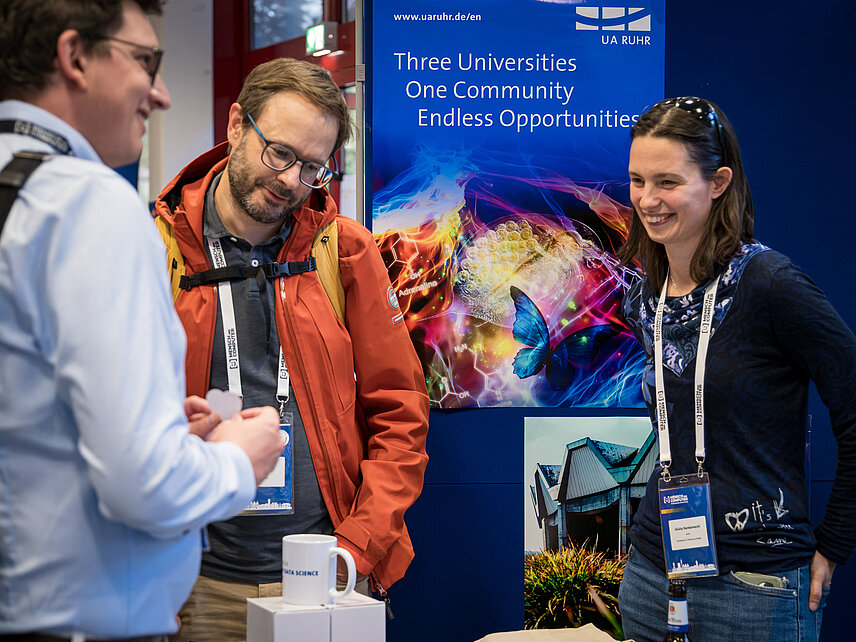 Photo: © Ali Askari/MuC 2026
Interactive technologies do not simply change how people act, communicate, or work. People also make choices about how these technologies are designed, governed, and embedded in society. This two-way relationship was at the heart of Mensch und Computer 2026 under the theme “Transforming Interactions.” From August 30 to September 2, researchers and practitioners in human-computer interaction met at the University of Duisburg-Essen in Duisburg. RC Trust supported the conference, with researchers contributing both to its organization and scientific program. The Center also sponsored drinks for the welcome reception and poster session, supporting two of the conference’s informal spaces for exchange.
Helping shape the conference
For Giulia Barbareschi, involvement in MuC’26 began behind the scenes. Giulia Barbareschi, who leads the Inclusive Technology and Collective Engagement group at RC Trust and the University of Duisburg-Essen, served as one of the conference’s DEI & Accessibility Chairs. Together with Oliver Vaupel, Giulia Barbareschi was responsible for this area within the organizing committee.
Jonathan Liebers took on another part of the conference organization. Jonathan Liebers, a postdoctoral researcher in Sven Mayer’s Human-AI Interaction group, served as one of three Short Paper Chairs alongside Henrik Detjen and Maria Wolters. The role placed Jonathan Liebers on the organizational side of the scientific program as well as among the researchers contributing work to MuC’26.
Toan Quoc Nguyen and Aria Kalforian contributed behind the scenes by supporting the conference as student volunteers, helping keep everything running smoothly. Their tasks included helping out at the registration desk, setting up venues, and capturing candid moments as part of the social media photography team. Beyond the day-to-day tasks, they described it to be a genuinely rewarding experience both personally and professionally. It offered them a front-row seat to the event and plenty of opportunities to expand their networks within the wider German HCI community.
From standing desks to smart glasses
From a standing desk that moves on its own to a framework for experimenting with smart robotic environments, Sven Mayer’s contributions appeared in very different parts of the MuC program. Sven Mayer and members of the Human-AI Interaction group were involved in HCI sessions, short papers, demos, and Work in Progress research. The topics included autonomous standing desks, smart environments, categorical color palettes, interaction-log analysis and EEG-based approaches to perceptual similarity.
One contribution brought several members of the current RC Trust group together. Soumik Bhattacharjee, Aria Kalforian, Fiona Mariele Lau, Toan Quoc Nguyen, Sven Mayer and Jonathan Liebers worked on the co-design of AI-powered smart glasses for life-logging applications. The project was presented as Work in Progress poster at MuC’26.
Who controls an AI conversation?
Who gets to shape our interactions with AI? Several RC Trust contributions at MuC’26 approached this question from different angles. Anna Neumann presented the previously published CHI 2026 paper on system prompts, co-authored with Yulu Pi and Jatinder Singh from the Compliant & Accountable Systems group, as an invited talk in the session Human-AI Trust & Agency. The work examines how hidden system instructions shape interactions with generative AI and what users expect in terms of transparency and control.
Anna Neumann was also involved throughout the conference as a student volunteer. On the opening Sunday, she joined the workshop Human-Centered Content Moderation: Expertise, Context & Evaluation, contributing work developed with Jasmin Wyss, Ivy Turk, and Rebekah Overdorf. Their short paper examines the idea of using community moderation policies as prompts for large language models and the community governance risks that can follow from this approach.
A further connection to RC Trust appeared in the short paper program. Nils Köbis and Markus Pauly were among the co-authors of a contribution examining LLM-generated hints for students recovering from errors while programming.
About Mensch und Computer
Mensch und Computer brings together research and practice in human-computer interaction, including human-centered design, interactive systems, and digital technologies. The annual conference connects researchers, practitioners, and industry professionals and provides a platform for scientific work as well as exchange between academia and practice. The 2026 edition was hosted by the University of Duisburg-Essen under the theme Transforming Interactions.
Contributions involving RC Trust researchers
Standtroller: The Autonomous Standing Desk Controller
Luke Haliburton, Teodora Mitrevska, Johannes Kleine, Sven Mayer
Publication
AIKitchen: A Rapid Prototyping Framework for Exploring Dynamic In-context Behavior of Smart Robotic Environments
Carl Oechsner, Jan Leusmann, Xuedong Zhang, Thomas Weber, Andreas Martin Butz, Sven Mayer
Publication
3D Dreams Are Made of This – Comparing Sketching on XR and Tablet Devices as Input Modalities for 3D Model Generation
Niklas Pfützenreuter, Jonathan Liebers, Roman Heger, Henning Maly, Steven Tischer, Anh Duy Dao, David Goedicke, Stefan Schneegass
Publication
Who Controls the Conversation? User Perspectives On Generative AI (LLM) System Prompts
Anna Neumann, Yulu Pi, Jatinder Singh
Publication
It is not enough to give your moderation rules to ChatGPT: Policy-as-Prompt Moderation and Its Potential Impacts on Community Governance
Anna Neumann, Jasmin Wyss, Ivy Turk, Rebekah Overdorf
https://arxiv.org/abs/2607.12149
Towards Adjacency-Aware Categorical Color Palettes: Algorithm, Evaluation, and User Preferences
Kathrin Schnizer, Dominik Fuchs, Sven Mayer
Publication
What Makes Usability Smells Detectable? On the Role of Representation in Interaction Log Analysis
Michelle Xiao-Lin Foo, Sven Mayer
Publication
EEG Components as an Implicit Channel for Perceptual Similarity Evaluation
Teodora Mitrevska, Baiyu Chen, Sven Mayer
Publication
Exploring LLM-generated hints for students’ Error Recovery in programming
Bibeg Limbu, Kaimao Sheng, Mona Münstermann, Yasin Esiri, Falk Howar, Nils Köbis, Markus Pauly, Nikol Rummel, Irene-Angelica Chounta
Publication
Co-Designing AI-Powered Smart Glasses for Life-Logging Applications
Soumik Bhattacharjee, Aria Kalforian, Fiona Mariele Lau, Toan Quoc Nguyen, Sven Mayer, Jonathan Liebers
Publication
Track-Anything-3D: Integrating the Tracking Electronics of the Meta Quest 3 Touch Controllers into Arbitrary 3D-Fabricated Objects
Florian Rademaker, Roman Heger, Marvin Strauss, Jonathan Liebers
Publication
Category
- Network
- Event
- Inclusive Technology and Collective Engagement
- Human-AI Interaction
- Compliant and Accountable Systems
Author
Patrick Wilking